



Diehard Exclusive

Unlock Your Full Philadelphia Flyers Experience
This premium content is a Philadelphia Flyers Diehard exclusive.
DIEHARD MEMBERSHIP
$79.99
/year
As a Diehard, you'll get:
Plus
Join Now
Cancel anytime. No questions asked.
Manage Membership
You're already a Diehard! Manage your subscription from your dashboard.
Already a Diehard?
Sign In
13 Comments (5 conversations)
Kevin Busby
This team is really starting to feel like they’re only a 1C away from being pretty darn good. Wonder if a change of scenery for Pettersson in VAN would get him back on track. Maybe a combination of Farabee, draft picks, and a B level prospect gets it done in the offseason?
guadzilla
They dont have a lot of elite talent but they have excellent depth and a really solid structure/coaching. I wouldn’t mind seeing them give up a couple of the younger prospects to get a potential 1C – you can replenish a lot of 2nd line talent with the draft picks they DO have.
Bob MCH
They need an elite 1C, agree, but they also need an elite 1D and an elite Goalie. Those are the 3 essential building block piilars needed. Instead they keep going with the fill in “depth” instead. To prepare to be a perennial cup contender, first they must get the 3 key elite pillars.
Jack Berlin
Maybe my eyes fooled me, but it sure looked like Luke Hughes fanned on that cross ice pass that went directly to couturier. More of a gift than anything.
guadzilla
Despite what the analytics say, the Flyers did NOT win the scoring chance war, IMO. Other than the blocked shots, the Devils got several high quality shots and re-directs that missed the net. The Flyers didnt have nearly as many quality attempts.
And speaking of quality attempts, thing that stood out to me: the Devils forwards were much better at finding proper shooting lanes past the immediate checker, whereas so many of the Flyers shots get blocked by sticks of the guy right in front of them. They also mis-play a lot of passes – Michkov would likely have 5-10 more points this season if he had a true 1C to play with.
PS: The Devils arent doing anything in the playoffs. A lot of talent but they lack the grit that you need to grind it out series after series in the playoffs.
Charlie O'Connor
AuthorNo, they did. Particularly at 5-on-5, where the Flyers led 12-1 in high-danger chances. The Devils did get a fair amount of chances on the PP, but not enough to make up for the enormous gap at 5-on-5.
You can’t just state something incorrect with absolute certainty and make it true.
guadzilla
There is an “IMO” added there, you know.
And speaking about “stating something incorrect with absolute certainty”: there is simply no way that the Flyers had a 12-1 advantage in high-danger chances. Off the top of my head, I can think of atleast 4-5 dangerous chances that the Devils had where they failed to connect, or shot wide.
I like analytics but having worked with data for a living at one point, I also know the weakness of just relying on data (especially applying data pulled from cumulative averages to specific instances).
You cannot possibly have seen the game and thought that the Devils only had one high-danger chance, either.
guadzilla
(And I am referring to 5vs5 play as well)
Charlie O'Connor
AuthorHigh-danger chances are basically chances from the crease/netfront area and low slot.
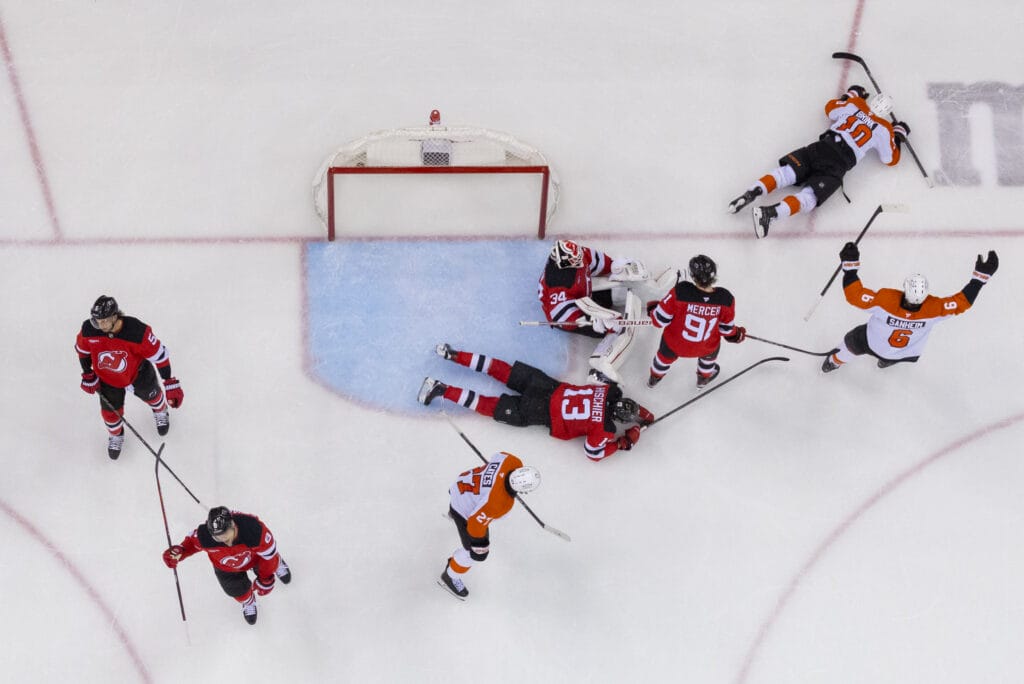
So yes, I do think the Flyers did an exceptional job of keeping the Devils out of those areas. They basically kept them to the outside the whole game. Their one goal was a distance point shot through a ton of traffic.
Is it possible that the NHL trackers missed on a couple shot locations? Sure. But the Flyers would still have a massive edge.
guadzilla
I get that and let me preface this by saying that I am a big fan of numbers/objectivity: one of the reasons I am a huge fan of your articles is because of the numbers-driven analysis that you provide.
That said, statistical numbers need to be taken in context. To use an example of a shot from the slot – averaged over X shots from that area over 1300-odd games a season, yes, they can be high danger shots. But that doesn’t mean a smaller set of 5 shots from the slot in a particular game are necessarily high danger shots. Each shot has significant variance and the smaller your sample size, the greater the variance.
To use a different analogy – if stats say that the average suburban household has 0.8 dogs, that doesn’t mean a street with 10 houses is going to have 8 dogs.
To use a few specific examples from this game:
– the Flyers got off several shots from inside the slot, while having some separation from the defensemen (which is factored into the model). So in theory, shots from a relatively high danger area. Except in atleast 3 of those instances, the D-man got a stick on the shot and deflected it. So in this instance, not exactly as dangerous as they could have been
– There is one shot the Devils took from the point – a seeing-eye wrister that slithered through a whole lot of players, got deflected and required Ersson to make a save that was part positioning/part luck/part reflexes. That, typically, would be a pretty low-percentage chance but in this case, was not.
– There was atleast one instance where the Devils had a great cross-ice pace that had Ersson scrambling across the ice but their forward whiffed. Does that count as a high-danger opportunity?
Without getting into the meat and potatoes of how these numbers are calculated, I think it is fairly clear that each individual “shot from the slot” has a reasonably high variance of danger than implied by the cumulative “danger rating” of that shot. So while these analytics numbers are directionally useful over large sample sizes, it doesn’t make sense to hold on to them as gospel truth with much smaller sample sizes. Subjective assessment can sometimes have a lot of validity as well (especially in small sample sizes, where you dont have to rely on using statistical proxies for “danger” but can actually just count them out).
TL;DR: If you want to have a discussion on the specifics of the high danger chances, or you feel that the analytics tell a more accurate story than subjective assessment in this case, that’s fine.
But less of the dismissive “You can’t just state something incorrect with absolute certainty and make it true” – leaving aside the slight condescension in that (which doesn’t bother me that much), that statement implies a level of .. ahem…absolute certainty.. in analytics which is not be merited.
guadzilla
As an aside that isn’t really relevant to anything we were discussing – one of the models apparently did try to take into account a shooter’s skill level in determining the level of danger in a shot. Interestingly, one of the more popular models that came afterwards stopped doing so. I would have thought that factoring in skill level would refine the model more, but apparently not.
(I forget which models – I had tried to do some research to understand the methodologies but either found something incredible facile or something requiring me to go through tens of citations, which aint happening for a hobby)
Jason
Good to see Bobby Brink get rewarded recently. He’s taken some big strides this year.
Bob MCH
Torts needs to go and right now. But not for the reason one might think. He is to good a coach for the Flyers to get a top five draft pick. Which means, he is blocking their ability to acquire an elite superstar talent, and they need at least 3 more (Michkov is their only one in development), a 1C stud, a 1D superstar, and an elite goalie. Under Torts, Flyers will land in the 15 to 25 first round draft area and there are no elite talents being acquired in that range these days. Torts is the coach you want AFTER the talent is acquired, not before. Its cart before the horse and is impeding this rebuild. If you want long-term success, you better get your hands on 4 or 5 under 21 year old elite studs, or forget any hopes for a cup in the next decade. Jonesy and Brierre need to get real here, and make some tough decisions to get superstar pillars to build around. Start with the pillars, get the coach, then fill in around the edges. That has to be the order of events for building a cup. Their work is backwards.