
The NBA’s most pressing issue, to me, revolves around why its postseason feels so different from its regular season. The league believes it can be solved with anti-tanking rules; others feel the games simply aren’t significant enough. That why and what to do can be debated infinitely. What’s more interesting, with half of this 2026 NBA postseason’s first round series concluded, is how they’ve changed.
Which is that, this century, we’ve never seen a larger scoring decline from the regular season to the playoffs.
The Denver Nuggets, the league’s best scoring regular season offense, scored fewer than 100 points just twice before the playoffs began. When eliminated on Thursday, Denver surpassed that, scoring fewer than 100 points for the third time in this first-round series against the Minnesota Timberwolves. We’ve seen the following scores decide games: 93-89, 94-88, 99-93. Those three results all came from different series.
VOTE IN OUR ‘STATE OF THE NBA’ FAN SURVEY
This postseason, teams have averaged 8.1 fewer points than they did in the regular season, which is the second-largest decline in the 21st century, and 4.1 fewer points per 100 possessions, which is the largest, per Basketball Reference. (While I was digging into this trend, ESPN’s Zach Kram beat me to it with this good story.) Teams have seen their average True Shooting percentage decline by two percent, another fall that’s the most significant since the 2000-01 season. Typically, offenses have performed slightly less efficiently than they do in the regular season … but never like this.
If these postseason games have felt like grueling slugfests, it’s because they have been. Here are the reasons we’ve seen that explain it.
It’s not fully explained by officiating.
Teams have actually shot more free throws since the postseason began than they did in the regular season. Before this first round, teams attempted 0.21 free throws for every shot taken, which has increased to about 0.23. In raw numbers, we’re seeing about 1.5 more free throw attempts each game despite teams averaging about three fewer possessions per game.
That said, the eye test does indicate there has been more contact allowed since the calendar turned in mid-April. One assistant coach for a first-round team specifically identified off-ball contact, telling me last week, “I feel like you can get away with anything off the ball. It doesn’t make sense to guard any other way.” There clearly has been a ball denial trend throughout this postseason, one made possible by the amount of off-ball contact we’ve seen happen without any whistle.
In other words, one explanation is that physicality has increased more than the whistles have.
There also might be some incidental variance at play with the free throws, which teams have shot more than two percent worse on compared to the regular season, a trend that’s unusual compared to the past few seasons. (It usually stays about the same.) Teams have seen their 3-point percentage decline, too, from 36.0 percent to 34.4 percent. That’s more explainable by a team’s defense, however; GeniusIQ indicates the shot quality of such 3-pointers has declined by about one percent. Players are underperforming on catch-and-shoot 3s far more than the regular season, however.
The regular season was inflated vs. bad teams.
In the regular season, every single team’s offense (except Orlando’s) was notably worse when facing teams with a top-10 point differential, which teams are facing more often in these playoff settings, of course, than they did in the regular season. These are the league’s 16 postseason teams, their offensive ratings in the regular season in total vs. when they faced top-10 teams, and the differentials. These teams’ performances changed more prominently on offense than defense.
| TEAM | ORTG | ORTG10 | ORTG DIF |
| Denver | 122.5 | 118.3 | -4.2 |
| Boston | 121.1 | 114.4 | -6.7 |
| San Antonio | 120.3 | 117.3 | -3.0 |
| New York | 120.2 | 116.2 | -4.0 |
| Oklahoma City | 119.2 | 113.3 | -5.9 |
| Houston | 118.9 | 113.6 | -5.3 |
| Cleveland | 118.9 | 114.8 | -4.1 |
| LA Lakers | 118.5 | 112.3 | -6.2 |
| Detroit | 118.3 | 115.2 | -3.1 |
| Toronto | 116.8 | 110.8 | -6.0 |
| Minnesota | 116.8 | 115.3 | -1.5 |
| Atlanta | 116.3 | 112.3 | -4.0 |
| Phoenix | 115.5 | 112.3 | -3.2 |
| Philadelphia | 115.5 | 109.9 | -5.6 |
| Orlando | 114.8 | 114.8 | 0.0 |
In the postseason, teams can strategized better and more thoroughly against every opponent they face. We’ve seen offenses we didn’t trust struggle: Detroit, Atlanta, Orlando, and Portland. Most teams are struggling to find open catch-and-shoot looks for their best shooters, which stems from the suppression of many team’s favorite actions, which players adjust to throughout the course of a series.
This doesn’t explain why Denver’s offense fell apart; the Nuggets were about 12 points per 100 possessions worse than their overall regular season mark and still 10 points worse than even when they faced top-10 teams. That’s a unique collapse, one that might influence these numbers, too: The NBA’s best offense underperforming this badly in the postseason does affect this sample size given it’s still relatively small.
Still, it was easier than ever this season for good teams to run up their numbers against bad ones. That only makes the difference between ho-hum regular season hoops and what we’re now seeing nightly more pronounced.
The result is tighter, more grueling games.
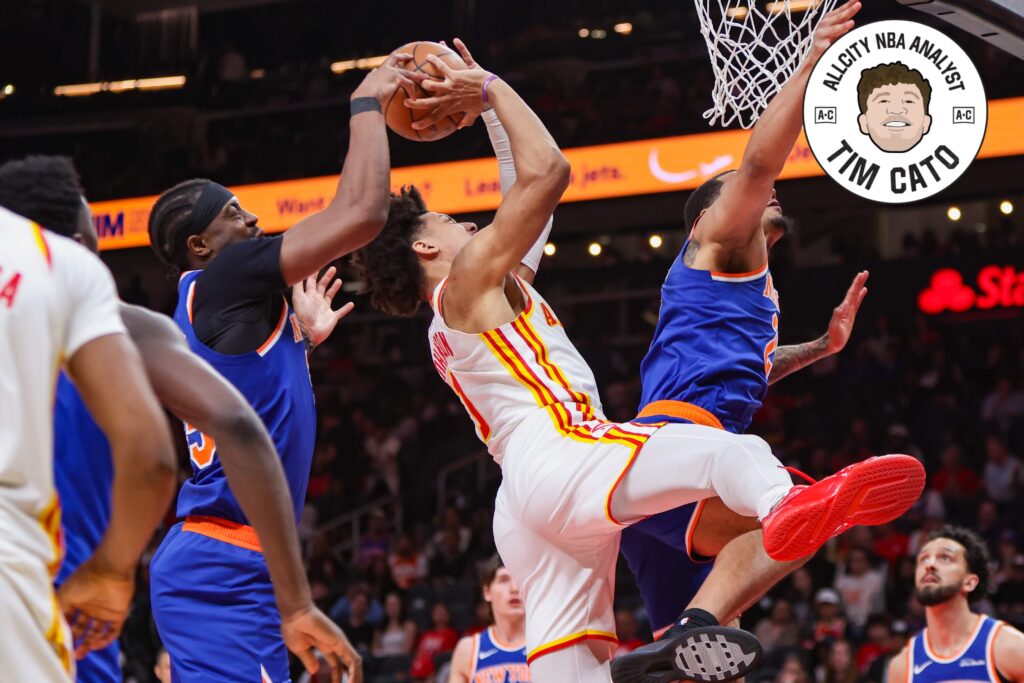
Detroit and Orlando has served as a premier example of a series that should push back against the NBA’s critics who complain that scoring’s too easy. These teams have played physical, hard-nosed basketball; they play mid-range maestros and both struggle to shoot 3s at the rates most teams do in this era; they absolutely cannot score efficiently. It’s been a brilliant series to watch, one which is more enjoyable to view through the lens of two monstrous defenses than the other way around.
Broadly speaking, I believe these first-round games are the type of basketball we all want to see more often. We can blame, to some extent, the statistical inflation we’ve seen from fewer competitive teams than ever down the stretch of this regular season. But we’re also seeing more physicality, more contact allowed, and defenses that have caused offensive machines from the regular season to stutter and cough in its efforts to score like they’re accustomed to.
In a league that’s more skilled than it’s ever been, these players are being forced to prove it to put points on the board. That’s good for basketball.
Tim Cato is ALLCITY’s national NBA writer currently based in Dallas. He can be reached at tcato@alldlls.com or on X at @tim_cato.