


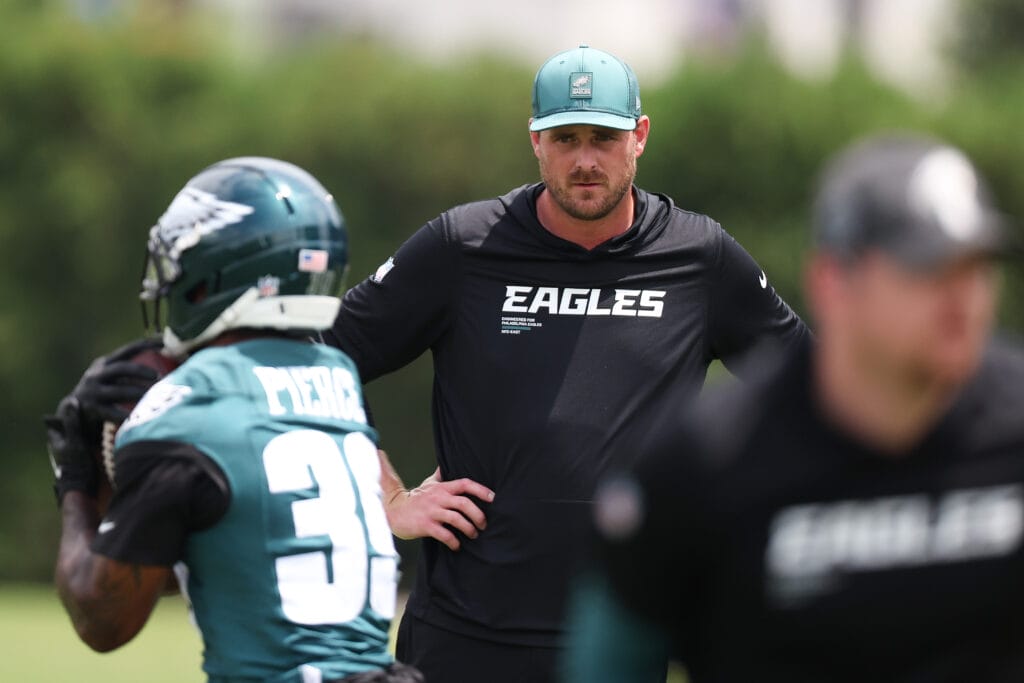
An ice cream truck beckoned in the parking lot adjacent to the Eagles practice fields Wednesday afternoon, essentially representing the first opportunity for 91 players and their visiting families to celebrate the end of spring workouts and the beginning of summer break.
Cam Jurgens had barely gotten through a third of his chocolate sundae by the time he stepped up to the podium (more on him later,) but there will be plenty of time for dessert nonetheless. The Eagles finished the final phase of the NFL offseason program and will now have a six-week break before training camp.
Here are five things we learned about the Eagles’ new-look offense over the course of four open practices stretched across three weeks:
1. Sean Mannion has completely remodeled the offensive scheme, and that’s going to take time
It shouldn’t come as much of a surprise to hear that the Eagles defense was consistently the more successful unit during each practice, but it’s still a necessary note in reflection of the four open sessions. The Eagles first-team secondary looked as advertised against a reworked and undermanned wide receiving corps and more often than not Jalen Hurts, Andy Dalton, and Tanner McKee were either targeting running backs or tight ends on underneath routes or holding onto the ball for extended periods without finding someone downfield.
But even setting aside the imperative caveat that most defenses are ahead of their offensive counterparts at this point in the offseason, it’s important to remember just how wide the gulf is between the Eagles offense and defense in terms of both a personnel and schematic continuity standpoint this summer. For as significant a change as the Eagles defense had to go through in 2024 when Vic Fangio took over, this Eagles offense has had an even bigger task with several new faces and an offensive system that shares almost no resemblance to the one the group ran last year.
In fact, those who have seen it up close for the duration of the spring believe it couldn’t look any more different than last year’s offense.
And while the “art” of statkeeping during practices doesn’t ruffle my feathers as much as some, what you glean from that information should be far from conclusive. I mentioned earlier that most of Hurts’ completions came on either checkdowns to the running backs or tight ends or hitting receivers on shallow crossing routes, and it’s entirely plausible to believe Sean Mannion spent this spring working on the foundational passing concepts that may not set off fireworks, but will keep the offense on schedule if everyone is in sync on the timing and details of the plays. That’s what spring practices are for, laying the foundation rather than filing up a statsheet.
All this to say, we are judging a majorly incomplete picture of the Eagles offense, going against a defensive group that’s had years to build a strong foundation with one of the best defensive coaches in charge of a talented nucleus that have now spent years playing important football together.
2. Some clarity on Mannion’s scheme
Where exactly Mannion falls on the spectrum of the offenses authored by products of the Kyle Shanahan-Sean McVay coaching tree has been hard to pin down. There are a handful of different flavors of these systems by now, but Dontayvion Wicks’ answer to how many questions he’s fielding from his teammates about his time playing for Matt LaFleur shows it’s probably not as closely aligned to the Green Bay Packers as Mannion’s two years on staff there might suggest.
“I’m asking questions myself, because everything ain’t set,” Wicks said. “We’re all still learning the offense and the new ways of doing things here in Philly. So, I get some questions regarding what I know, but we’re all still learning.”
What we do know is the Eagles plan to have Hurts under center much more than they have in years prior. The majority of the offensive snaps came out of under-center formations during the spring and the coaching staff has talked about the transition from an inside-zone heavy run scheme that allowed Hurts to be plus-one in the run game to a system centered around wide zone and under-center play-action passes off of those runs that will present the same look to the defense.
But it’s best to assume there will be some individuality to the scheme Mannion is authoring. The stories of his time preparing to become a coach during his playing career should be instructive, he didn’t just start envisioning what his call sheet would look like when he started working for LaFleur.
“Sean had his own playbook while he was a backup quarterback,” said Eagles offensive line coach Chris Kuper, who overlapped as a coach with Mannion as a player on the Minnesota Vikings. “He was just building it as a player. … He had a true binder full of plays that he was deciding whether his offense was going to [include] or not, and he’s evolved from there.”
3. The most encouraging signs happened at the podium, not the field
Taking a more long-term view, one of the most encouraging aspects of the last month has been just how receptive key members of the Eagles offensive nucleus have been to the wholesale changes Mannion has brought.
Hurts, who once opined that Kellen Moore’s offense was “95% new” for the quarterback, has been consistently enthusiastic about what Mannion has installed despite it requiring the 27-year-old to change the way he operates to a significant degree.
“I thought it was a really good spring,” Hurts said Wednesday. “To be able to onboard another new system, put it all together. Lay a foundation. I’m encouraged by that. I’m encouraged by what we were able to put in.”
A day earlier, Eagles right tackle Lane Johnson said the new system will be much friendlier to offensive linemen and more effective at keeping defenses from keying in on what they’re doing pre-snap. So advantageous, in fact, Johnson said he’s been watching schemes with similar roots from afar for years with envy.
“I’ve watched this system, the [Gary] Kubiak-Shanahan styles of offense from afar, and have also envied and wanted to be a part of it. Here I am after all these years. Not saying we’re going to be better, there’s a lot to learn. But I think we have the ability to be more than we were last year, be a lot more than what we were in the run game. I think it’s going to open up the pass game, too.”
That level of buy-in is important, especially considering how frustrated the key members of the offense grew by the midway point of last season as things grew stagnant and, as Johnson put it the last time he spoke to the media back in October: “Predictable.”
Another stark contrast this spring? Saquon Barkley and Cam Jurgens pointing out the benefits of under-center running angles compared to the shotgun runs the Eagles majored in during previous seasons. Take it from someone who has covered the two for the last few years and asked/heard questions about the differences; Barkley and Jurgens haven’t always felt strongly about the difference.
There are plenty of questions left to answer to determine whether Mannion will be as good as a first-time offensive coordinator as the Eagles believe he can be. He’ll have to hit the ground running as a play-caller, author efficient opening series and plenty more. But what’s become clear this spring is important for a coach commanding a room and an offense for the first time in a young career: He’s done an effective job communicating his vision for this offense and has gotten buy-in from the players he needs it from.
“His ability to lead, lead men and lead coaches, he hasn’t been doing this a long time, but he’s an organized person, he knows what he wants, and he’s very clear and concise,” Kuper said. “The job description is very black-and-white, which is what we all want. It’s what the players want, so that we can present them with something that is black-and-white.”
4. Makai Lemon and Eli Stowers both got off to slow starts
For as encouraging as the early returns on the system may have been, the spring wasn’t kind to the Eagles’ pair of rookies hoping to thrive in it.
Makai Lemon suffered a hamstring injury early in OTAs and watched from the sidelines during the entirety of mandatory minicamp. Stowers participated in practice, but was seldom used during team drills and was mostly invisible as a result.
It’s too early to overreact with either player, but each of them already had the uphill battle of acclimating to the NFL in a truncated offseason dominated by draft preparation. And in Stowers’ case, hitting the ground running (and perhaps healthier) in training camp will be vital to carving out a meaningful role at all during his rookie season.
5. The early indications are that Cam Jurgens and Landon Dickerson have benefitted from an offseason to recover
After the way last season ended for Cam Jurgens, Landon Dickerson, and Lane Johnson, perhaps the biggest needle-mover from the spring was the levity that has seemingly washed over each of the starting offensive linemen.
Jurgens and Dickerson both traveled to Columbia during the offseason to get stem-cell therapy treatment, Jurgens for a chronically injured back and Dickerson for the litany of ankle and knee injuries he’s suffered during his career. Johnson didn’t take the trip, but did seriously consider retirement early in the offseason and finishing the year with a Lisfranc foot injury that he wasn’t able to play through despite a persistent effort to in the season’s final weeks.
Jurgens said he’s noticed a significant improvement in how he feels compared to last offseason when he spent most of his time rehabbing, and Dickerson seemed to be moving well without any braces or sleeves on his legs during mandatory minicamp.
We’ll see how the group looks when the pads come on in training camp, but a marked health improvement for the trio in 2026 would go a long way toward laying the foundation for the Eagles as a team hoping to get the most out of Barkley and build a passing game off of play-action fakes.

2 Comments (1 conversation)
Jim Kempner
I’m optimistic about the new offense, actually, any new offense (as in not predictable), but the key will be a (hopefully) healthy offensive line.