

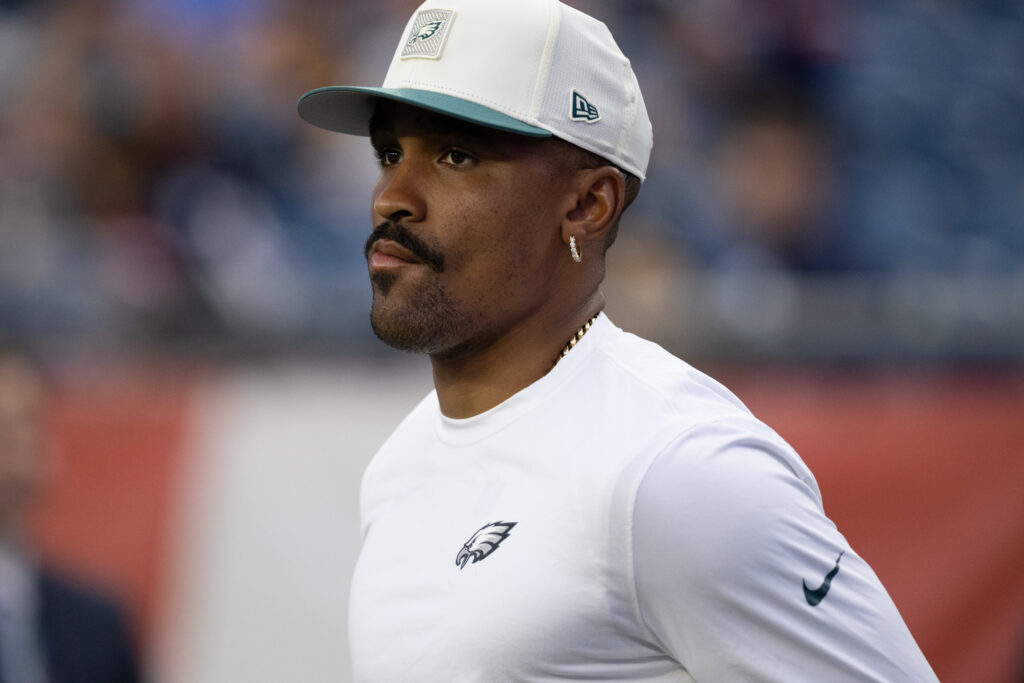
There’s a new Jalen Hurts piece out from GQ that all the cool kids are talking about.
I promise not to go off on a long, boring tangent about how there was a time, long ago, when access to top players was a lot easier for the local writer-folk, and seeing that a guy you talked to all the time had sat down with a national publication might merit mention in your notes, if at all.
But times have indeed changed. In 2026, the Eagles quarterback grants one-on-one, away-from-the-facility interviews about as often as I write something that gets quickly to the point. (It has happened, I swear.)
So GQ writer and former Philly guy Zach Baron’s conversations with Hurts this summer on the Art Museum steps at 5 a.m. and while shooting pool at a private Center City club, presumably at a more decent hour, are a pretty big deal in the Eagles media universe. Especially with the team not scheduling any media sessions with players this week.
Baron is a big-time journo and a thoughtful interviewer, but Hurts is gonna be Hurts, with everyone. The headline asks if anyone can decode “the NFL’s most cryptic quarterback.” Maybe Baron managed to do that just a little, but I can’t say I came away with a greatly expanded sense of who Hurts is off the field.
Mostly the piece reinforces things I’d seen for myself or been told. This is a player who grew up as the son of a famous high school football coach, in Texas. Baron might be the first person ever to ask Hurts about expressing vulnerability; when you grow up aware that all eyes are on your family, and eventually on you, “vulnerable” surely does not seem like an option. The circling wolves would quickly sniff that.
In this sense, Hurts reminds me of the first Eagles quarterback I covered, Donovan McNabb. Dmac could goof it up for the cameras on gameday, which Hurts certainly does not, but early in his career, in particular, McNabb felt he needed to be the spokesman for Black quarterbacks, back when that was a real thing.
This was a kid whose family’s house was vandalized when they moved into an all-white Illinois neighborhood. As an adult, he had to listen to Rush Limbaugh on ESPN calling him overrated, a creation of the white liberal media.
Back then, it was hard to get anything from McNabb that sounded heartfelt or genuine – everything seemed to be processed through the filter of “here is what I, as a prominent Black quarterback, feel I should say on that matter.”
Hurts speaks from behind a different wall, but it’s a wall, nonetheless. He tries to project leadership and maturity at all times. I’m not around the locker room these days. Reporters who are regularly there have mentioned to me that Hurts’ aloof, carefully controlled manner doesn’t always resonate with teammates. He is so focused on winning, he comes off as joyless, certainly in press conferences, but apparently in more private settings as well.
This gets us to the part of the GQ article that will probably arouse the most interest, when Baron queries Hurts about the distance that opened up between the quarterback and his best receiver, A.J. Brown, culminating in the trade of Brown to New England this offseason. Hurts finally concedes that they “clearly” grew apart. He doesn’t explain how or why that distance grew, but I think we can take a pretty good stab at figuring it out.
After the Eagles won Super Bowl LIX, Brown made an extraordinary admission: Winning wasn’t as satisfying as he’d thought it would be. He said – paraphrasing here – that he’d come to realize that winning would only satisfy him if he also was personally dominant.
I think that maybe Brown was, as some have said, frustrated with Hurts’ limitations as a passer, but more than that, I think he wanted out of here because he knew that in a Hurts-Saquon Barkley offense, regardless of scheme, he was never going to be the focal point. With Hurts as the QB and Barkley running behind an elite offensive line, the Eagles are not going to throw the ball 40 times a game. No wideout is going to dominate. You didn’t hear anything about Brown being unhappy the year before Barkley arrived, when Brown caught 106 passes for 1,456 yards.
Hurts, meanwhile, has shown through word and deed that his mindset is exactly the opposite. Winning is everything. If he throws for 100 yards and the Eagles win, he feels reasonably OK about that. Even if critics feel he could and should have thrown for much more.
“It’s a game where we’ve all got to have a shared mission,” Hurts tells GQ, in relation to his rift with Brown. “We all got to be in pursuit of the collective. And that’s not something I can speak on from his behalf, but I can tell you my focus has always been to pursue the mission.”
Hurts tells Baron that he thinks leadership is forged in deeds, not words. That’s obviously true, to some extent, but sometimes, in tough times, a leader needs to use words – words of encouragement, or words that help point the way forward. It isn’t clear that Hurts gets that.
Baron asks Hurts about a hypothetical teammate who might be wondering what the QB thinks of him.
“Let’s win” is Hurts’ answer.
That is who he is, for better or worse.