© 2026 ALLCITY Network Inc.
All rights reserved.



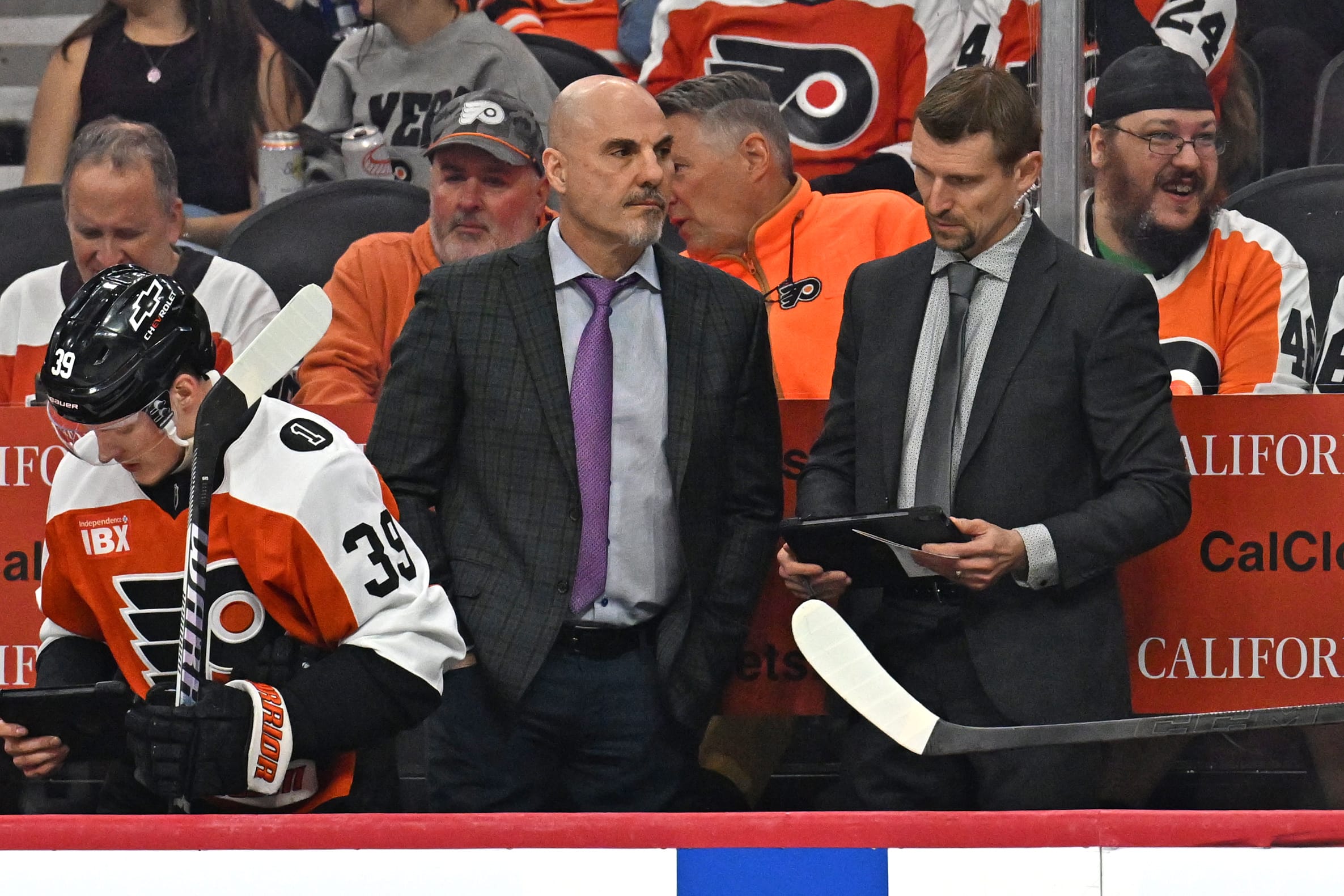
It’s late. The kind of late where everything feels like it’s holding its breath.
Not the arena.
This is the practice facility — tucked away in leafy Voorhees, South Jersey. Quiet roads. Dim streetlights. The kind of place you’d pass without a second thought, never knowing that inside, something is being built. No spectacle. No scoreboard. No roar of 20,000 voices to mask the truth.

Just the game.
Earlier in the day, it wasn’t quiet.
There was life in the building.
Skates carving into fresh ice. Sticks snapping pucks against the glass. Coaches barking, players answering. The rhythm of a team sharpening itself for something bigger than the moment in front of them.
They practiced.
Hard.
Intentional.
Then they went inside and turned to the screen. Penguins tape. Over and over. Shift by shift. Detail by detail. Tendencies. Entries. Where they attack. Where they’re vulnerable.
“They’re good,” Rick Tocchet said. “Real good offensive team. But we can win.”
That was the tone.
Honest.
Direct.
No fear.
And when the formal part of the day ended, Tocchet didn’t disappear into an office.
He went back out on the ice.
Just him and Porter Martone.
The building had quieted by then, but not completely. You could still hear it — the crisp snap of the puck, the scrape of edges digging into the ice, the repetition of something being honed.
Tocchet fed him pucks.
Stopped him.
Adjusted him.
Talked through it.
Where the shot comes from. Where the space opens. How to create it before it’s there.
Martone leaned in.
Listened.
Absorbed.
“Kid’s great,” Tocchet said. “He listens. Wants to get better.”
And Tocchet — a man who has lived this game at every level, who has seen it all — was right there in it with him.
Not above it.
Not removed from it.
In it.
Teaching.
Passing something along.
That’s how a team grows.
That’s how belief takes root.
Then came the dinner.
The chef laid it out — steak and lobster. Plates heavy. The kind of meal that slows everything down just enough to feel the moment. The guys sat together, laughing, leaning back, letting the tension loosen without ever fully leaving.
“The guys loved it,” Tocchet said. “Great day for our team being together. They’re excited.”
You could feel it.
That mix of nerves and anticipation.
That quiet understanding.
Something big is coming.
This was the moment before the madness.
Now it’s late.
The building has emptied.
The Zamboni has long since finished its last pass, but the cold still lingers, curling through the air. The smell is unmistakable — fresh ice, sweat, rubber, the faint bite of ammonia. Sticks lean against the wall like tired soldiers. A stray puck rests near the far blue line, untouched.
This is where teams are made.
Or where they come apart.
And tonight, it feels like something is being forged.
Rick Tocchet is still there.
It’s 10:30 PM and he’s just leaving — long after the players have filtered out into the Jersey night, long after the laughter from dinner has faded, long after the last car pulled from the lot.
The building has gone quiet around him.
But his mind hasn’t.
It never does.
He pauses before stepping out. Just a glance back. Not nostalgia. Not reflection.
Inventory.
Always inventory.
Because tomorrow they cross the state.
Tomorrow, it begins.
And you can feel it.
Not just in that building in Voorhees.
In the air across the region.
In the neighborhoods.
In the bars.
In the way people are starting to talk again — not about what’s broken, but about what might be.
Because this isn’t just a playoff series.
This is Flyers-Penguins.
This is Pennsylvania.
This is identity.
Philadelphia used to live for this.
Spring nights when the air softened and the city opened itself up. Windows cracked. TVs glowing behind curtains. Kids in oversized orange sweaters playing street hockey until their mothers called them in. Bars with hand-painted signs — WE GOT PRISM — FLYERS HERE — packed shoulder to shoulder, the volume turned up just enough to feel like you were inside the building.
It wasn’t just watching.
It was belonging.
You went from the bright April evening into the dark — that walk into the arena, that descent into something sacred. The annual rite. The chase. The belief that this was your time, your team, your city.
And then it stopped.
Dark springs.
No buzz.
No hum.
No meaning.
Just absence.
Which is why now, with the Flyers back, with the building alive again, with the chants returning, it doesn’t feel normal.
It feels like something has been restored.
At the center of it all is Tocchet.
He grew up here.
Was a matinee idol.
No. 22.
As tough as a Bully but too skilled to be one.
He could fight.
He could score.
Forty-five goals in ’88. Thirty-seven the next year. Forty after that. Not a passenger anywhere — not even in regal Pittsburgh, where he put up 48 goals and 61 assists skating alongside greatness in ‘92-93.
He embodied the town.
And the crest.
He talks about it all the time.
Because it means something to him.
Something to stand behind.
Fight for.
Believe in.
“The Flyers were always about the Flyers,” he said. “Always about the team. The crest. That means something.”
A few weeks ago, that meaning felt lost.
Mere weeks ago, the city was done.
Disgruntled.
Weary.
Exhausted by rebuilds that never seemed to rebuild anything.
The anger had faded into something worse.
Apathy.
He was paying for the sins of the past. They all were – especially the men in charge, Keith Jones, Danny Briere and Dan Hilferty. The frustration over botched plans. Over springs that used to belong to the Flyers and now passed quietly, unnoticed.
“My son said, ‘Dad, you’re getting killed online.’”
After a promising start, the slump hit.
And it hit the fans harder than a Berube right.
The diehards were tired.
But what Tocchet heard wasn’t just anger.
He heard a city missing its team.
And then came March 9. You don’t understand this run without that night.
The Rangers came in, and from the opening minutes something felt off. Not loud. Not quiet. Uneasy. Like the building didn’t trust what it was seeing.
The Flyers got exposed.
6-2.
But the score wasn’t the story.
The building was.
It was hollow.
Boos came, but not in waves. In scattered, throaty bursts. Disappointment more than rage.
That’s always worse.
By the third period, people were leaving. Jackets on. Heads down. Eyes drifting toward exits.
This wasn’t outrage.
This was resignation.
A fan base saying, we’ve seen this before.
After the game, the room emptied quickly.
Gear bags zipped.
Velcro ripped.
Conversations short.
Down the hallway, Michkov lingered, talking to Shesterkin in Russian — two countrymen sharing a quiet moment that had nothing to do with the noise around them.
And Tocchet?
He stood there.
No panic.
No theatrics.
Just watching.
Thinking.
Taking inventory.
He had heard it all.
And he didn’t flinch.
“We’re gonna get this right.”
At the time, it sounded like something a coach says.
Now, it sounds like something he knew.
Because what followed didn’t make sense unless you understood the plan.
They didn’t cave.
They didn’t chase something easy.
There was skepticism — Flyers guys running the Flyers. Was it vision or nostalgia?
Previous regimes folded.
This one didn’t.
They held the line.
And Tocchet absorbed the heat.
“There was a method to our madness.”
Everything centered around Michkov.
The prodigy.
The expectation.
The impatience.
Why isn’t he producing? Why is he on the wrong side? Why is he on the wrong line?
But Tocchet saw something deeper.
A young player learning how to exist inside a team.
So he sat him down.
Brought in his agent.
Went through the tape together.
Shift by shift.
Detail by detail.
Michkov saw it.
Understood it.
Adjusted.
Because hockey doesn’t allow for one man to carry you.
This isn’t Iverson lugging a franchise until Larry Brown can build something around him.
This is the room.
Always the room.
And Tocchet wanted it right.
Slowly, it came together.
Couturier embracing his new role.
Tyson Foerster coming back sooner than the doctors thought possible and giving them a desperately needed sniper’s shot.
Martone dropped down from the Frozen Four-less plunge — polished, tough, selfless. Everyone knew he was good. Nobody knew he’d be this good this soon.
And the group?
“They’re believing.”
After March 10, they played like one of the best teams in hockey.
.737.
Desperate.
Connected.
Alive.
“You know what, guys? We’ve been playing playoff hockey for a month.”
Now they cross the state.
And on the other side is experience.
Crosby. Letang. Malkin. Karlsson.
12,744 games of it.
They’ve lived in this moment.
But time is there too.
Crosby debuted in 2005.
Martone was born in 2006.
That’s the gap.
That’s the tension.
This is the Battle of Pennsylvania.
It’s never just hockey.
It’s pride.
It’s identity.
It’s ours versus yours.
And Tocchet?
He stands in the middle.“I can’t tell you how great it feels to bring playoff hockey back to the city,” he said. “This was my home. Then I go there, win Cups… now I come back here and we’re in this series?”
Pause.
“How does it get any better?”
Another pause.
“I haven’t even been able to enjoy it. I’m in scheme mode.”
Of course he is.
Because he’s still that player.
Toughness and skill.
Fire and feel.
A Flyer at his core.
Saturday night is coming.
The city is ready.
The rivalry is waiting.
And somewhere, back in that quiet building in Voorhees, long after the lights should be out, Rick Tocchet is still there in some form — thinking, plotting, chasing.
Because for him, this isn’t just a series.
It’s a return.
To the city.
To the crest.
To everything it ever meant.
And everything it might again.
And if you listen closely — past the hum of the rink, past the quiet of the night, past the years of frustration and false starts — you can hear it.
Faint at first.
Then building.
That sound.
That feeling.
Philadelphia, waking back up.
And this time, led by one of its own, it’s not remembering what it was.
It’s becoming it again.
Comments
Share your thoughts
Join the conversation

The Comment section is only for diehard members
Scroll to next article

Don't like ads?
Don't like ads?
