


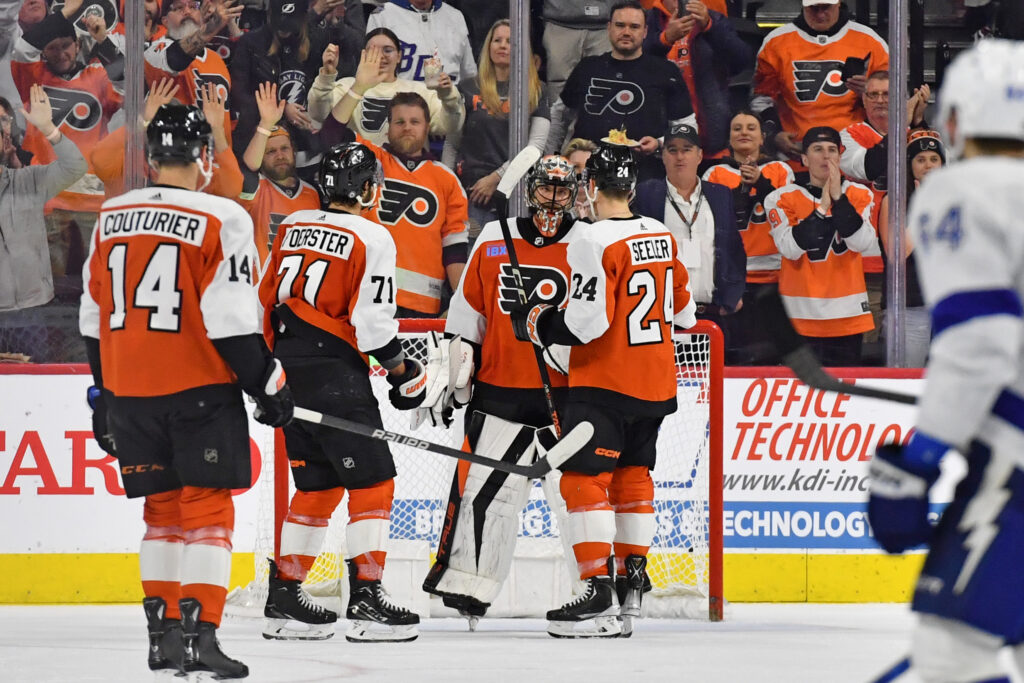
Go on social media, or message boards, or comment sections, and you’ll find quite a few fans of the Philadelphia Flyers who still simply don’t trust the front office’s plan to return the club to prominence.
Perhaps the number isn’t as high as it may at times seem. This group does tend to be especially vocal, which can drown out all of those who have watched the Flyers’ surprising 2023-24 campaign and are very much onboard with what general manager Daniel Briere, president of hockey operations Keith Jones, and the rest of the Philadelphia brain trust are selling.
But the doubters are there. They’re real. And in spite of the club’s resurgence in the wake of three consecutive dismal on-ice seasons, they remain either extremely skeptical of or utterly convinced that the Flyers are on the wrong track.
And it’s high time for those doubters to take a step back and reevaluate whether they’re truly being fair to the Flyers in reflexively railing against a rebuilding plan flush with promising early returns. A rebuilding plan that, while not certain to succeed — no plan is — it certainly has the potential to do so.

There are two lingering critiques of the Flyers’ plan: one that can be quickly dismissed, and one that deserves serious inspection.
The first is that Briere has been selling the fans a bill of goods, that he promised a rebuild and now is disingenuously pivoting to more of a middle-ground “retool.” But for those who have paid attention to Briere’s words and actions from the start, this criticism is nonsense. The Flyers have laid out their plan from the start, and have been remarkably transparent regarding their overarching philosophy.
In fact, on the very first full day of Briere’s tenure, when he was still interim GM, he made one key distinction clear: the Flyers would be rebuilding, yes, but they would not be tanking. The specific term he used was “fire sale,” but the sentiment was unmistakable — Briere had never promised a scorched-earth style rebuild. Then, in the wake of Briere’s first trade deadline last week, he clearly articulated one of the driving motivators behind avoiding a fire sale, when explaining why he chose to re-sign Nick Seeler and keep Scott Laughton: the importance of a strong, competitive culture upon player development and the overall success of the rebuild.
Briere and Co. have long believed this. There has been no pivot, no betrayal of past promises. This has always been their plan.
The second critique — that the Flyers’ chosen rebuilding plan simply won’t work in constructing a consistent Stanley Cup contender — is at least worthy of consideration.
The gist of the critique is simple. In this group’s estimation, aside from Matvei Michkov, the Flyers don’t have high-end, star-level players or ones with the upside to hit that level in the future. The best way to acquire high-end players is via the top-10 of the draft, yet the Flyers refuse to bottom out in order to make multiple selections there. Therefore, their plan is unlikely to produce anything more than a middle-of-the-pack club, since all of the top Cup contenders have not just one, but multiple gamechangers at the top of their lineups.
The Flyers, for their part, freely acknowledge the team’s need for more high-end talent. John Tortorella has noted the need for the club to produce via a by-committee approach due to the team’s dearth of superstars. Briere said the same back in December when speaking with PHLY, and reiterated it on Saturday’s Flyers-Lightning broadcast. Jones openly stated during his interview with PHLY in January that the Flyers as currently constituted don’t have the ceiling of clubs like Colorado due to the talent discrepancy at the top of their respective lineups, which plays into why the front office isn’t “going for it” just yet in terms of spending prime assets to chase down playoff wins.
But this honesty, in a way, just makes the doubters more angry. You know what the team lacks, they rail, yet you are purposely choosing to spurn the strategy most likely to solve the problem. No wonder why this contingent is so frustrated all the time.
But does the Flyers’ chosen path really make securing high-end talent impossible?
There are four ways, really, for a team to add top-end players.
- Draft in the top-10 a bunch of years in a row.
- Get lucky drafting outside the top-10.
- Accumulate assets, clear out cap space, & then trade for/sign them when available.
- Help existing roster players (or acquired reclamation projects) take leaps into stardom.
Drafting regularly in the top-10 isn’t the only way to get stars — it’s just the most straightforward. And yes, removing potential top-10 picks from the equation requires fans to have faith that Briere and Co. will make the right draft picks later on and/or execute on the right trades. But is it so difficult to believe that they could?
It’s not like every current Cup contender was built by bottoming out. There’s Dallas, a club with just one top-10 pick over the past ten years that constructed its roster around fantastic value drafting (Jason Robertson, Roope Hintz, Jake Oettinger) and shrewd free agent signings (Joe Pavelski, Matt Duchene). And then there’s defending champion Vegas, who lacked high-end talent to start but stockpiled assets to use to acquire stars via trade (Jack Eichel, Mark Stone) and free agency (Alex Pietrangelo).
There’s more than one way to put together a championship-caliber team.
And even if the Flyers had gone with the fire sale/tank strategy, that wouldn’t have been a foolproof strategy, either. Sure, after picking in the top-10 for five straight seasons, there wouldn’t be many doubters screaming that the Flyers lack young players with top-of-the-lineup upside. But there would be reason to worry that those high-upside guys would suffer through rocky developmental years absent sufficient teammate support on a gutted roster.
There’s precedent here. Buffalo, of course, drafted in the top-10 for ten straight years from 2013 through 2022 and still hasn’t been able to build a winning team — top picks like Rasmus Ristolainen and Sam Reinhart didn’t deliver their best seasons until after leaving the organization. Ottawa is loaded with exciting U25 players and continues to disappoint. Detroit had top-10 picks for seven straight years, and is just finally hoping to squeak into the postseason this season, while still getting bulldozed nightly at 5-on-5 (29th in the NHL by expected goal share). Even New Jersey, held up last season as an example of the merits of tanking (four top-10 picks in five years, including two first overall selections), has crashed back to earth this season.
All of these teams have talent — high-end talent. But none have been able to coalesce it into anything remotely resembling a sustainable title contender. Is it possible that the Flyers might be onto something here with their emphasis on team culture being essential to proper player development? Buffalo and Ottawa fans certainly would be open to the argument.
That’s not to say that tanking can’t work. The Avalanche, of course, are loaded with top-10 picks. Toronto’s turnaround was fueled by the Matthews/Marner/Nylander/Rielly group — all blue-chippers selected at the top of their respective drafts. Tampa Bay’s decade-long run of excellence began with the two core players — Steven Stamkos & Victor Hedman — that they nabbed with top-five picks.
But it’s not a strategy destined to succeed, either. Team building isn’t merely about acquiring the most young players with the highest ceilings. It’s about having the ability to mold them into stars that can carry your club. Had the Flyers chosen a tanking strategy, it wouldn’t have been a panacea to skepticism — it simply would have changed the nature of that skepticism.
Yes, the “how will you get high-end talent?” question is a viable and important one for the Flyers to face. But the question shouldn’t be deployed as a debate-ender, an exposé of how clueless the front office’s plan truly is. It instead should be presented sincerely, as an “OK, there’s good things going on here, but how will you acquire the big pieces to put you over the top?” query.
Of course, the obvious problem is that Briere and Jones and the Flyers simply can’t answer that question in a satisfying way right now.
If they have their eyes on a specific trade or UFA target, they’d be foolish to reveal it to the rest of the league until they actually acquire him.
Saying “we’re also going to trust that if we give our scouts enough opportunities, they can unearth a Jason Robertson (39th overall pick) or David Pastrňák (25th overall) or Sebastian Aho (35th) or Josh Morrissey (13th) or Brayden Point (79th) or Anze Kopitar (11th)” will only be met with eye rolls from skeptics — even if those kinds of draft wins do happen frequently.
Even contending that all of Tyson Foerster (on pace for 20+ goals and driving play at 5-on-5 in the 85th percentile among forwards by xG impact as a 22-year old rookie), Joel Farabee (ranked 22nd among NHL forwards in 5-on-5 Points/60 and delivering the best play-driving season of his career), Jamie Drysdale and Owen Tippett could plausibly take further steps in coming seasons and establish themselves as star-level talents can easily be dismissed as organizational wishful thinking, even if it remains a potential outcome for all of them, given the promising statistical signs (Foerster and Farabee) and exciting physical tools (Drysdale and Tippett) that they do legitimately possess.

Which brings us to the real sticking point here.
A full-throated endorsement of the Flyers’ plan does require a leap of faith. A belief that the people in charge will ultimately execute the right trades, or unearth the right draftees, or pursue the best development strategies. The loudest skeptics simply aren’t ready to take that leap after years of organizational incompetence, believing that only drafting in the top-10 can work, because uber-talented early picks are likely to emerge as stars even if the people calling the shots are fools.
But here’s the thing: That would be willfully ignoring all of the positive developments from the past year, all of the early, promising signs that the front office is not filled with fools, that their plan truly could work as they envision.
The Flyers have pulled off four significant reclamation projects — Tippett, Seeler, Sean Walker and Rasmus Ristolainen — over the past two seasons, speaking to this being a true organizational talent and not merely good luck.
They’ve stockpiled four first round picks and four second round picks over the next two drafts, speaking to the front office’s ability to successfully accumulate prime assets.
They’ve gotten all of Farabee, Travis Sanheim, Morgan Frost and even Travis Konecny (his two-way 5-on-5 work has improved tremendously in 2023-24) to take big statistical leaps this season, speaking to a newfound knack for pushing established NHLers to new heights.
They’ve successfully integrated all of Foerster, Cam York and Noah Cates into the NHL as clearly above-average players over the past two seasons, with Foerster and Cates in particular excelling by advanced metrics, speaking to improvements in player development, especially at the NHL level.
They’ve drafted what so far appears to be an excellent 2023 class, with Michkov, Oliver Bonk, Denver Barkey and Egor Zavragin in particular all delivering monster Draft+1 campaigns, speaking to a sound prospect evaulation process.
They stuck to their guns in prioritizing a long-term plan over short-term gratification in trading Walker for futures even while sitting in a playoff spot, speaking to the front office’s newly resolute nature.
Oh, and the NHL team is still pushing for that aforementioned playoff spot, and driving play at 5-on-5 while doing it, speaking to the quality of their underlying on-ice process and the strength of the team’s internal locker room culture.
Dismissing all of these undeniably positive signs is the fan equivalent of sticking one’s head in the sand. It’s pure stubbornness to continue to cling to a previous stance in the face of overwhelming evidence that circumstances are not nearly as dire and dismal as they once were.
Why not open your mind to the possibility that the Flyers just might be onto something here?
No one is saying that skepticism should be jettisoned entirely. There are plenty of ways this plan could go off the rails — the drafts might go south, Briere could make misguided trades (or no trades at all), Michkov might (gasp) bust or never come to North America. One can reasonably disagree on Morgan Frost or Bobby Brink’s game-over-game usage by Tortorella, or whether it was right to re-sign Nick Seeler, or if it’s wise to bet on Travis Konecny aging like a fine wine into his mid-30s by giving him a lucrative long-term extension this summer. Fan (and media) criticism serves to hold a front office accountable, and that will always be a good thing.
But the Flyers are nailing their reclamation projects. They’re stockpiling assets. Their young-ish NHL players are taking steps forward. Their prospects are emerging as useful NHLers, if not far more than that. Their drafting has been on point. They fought the temptation to take team-building shortcuts. And the NHL club is playing legitimately sound, solid hockey again.
It’s high time for the most vocal doubters to acknowledge that Briere and Co. have earned just a little benefit of the doubt via their work and results over the past season. Maybe, just maybe, you should consider giving it to them.

13 Comments (8 conversations)
David Peyton
Write-ups are excellent. I dropped my athletic subscription just read your columns again. Awesome work!
Charlie O'Connor
AuthorGreat to have you onboard!
mediator88
As always, Charlie, just what I needed today. I’m 46 years old and have never seen my favorite Philly team win their championship. I want so badly for Jones, Briere, Hilferty and crew to succeed here. Culture matters so very much. I’m on board with their direction and their focus. They just will need to be better-than-average drafters and developers to make it work. Developing talent? The early signs are good. Drafting? The Flyers haven’t been good at that for as long as I’ve been alive, it seems. They have the occasional hit (Giroux, Carter, etc.) but so, so many flubs. Can this Leadership team that around by rebuilding and/or enhancing the scouting and analytics departments? That’s where I have more uncertainty.
Scott Ferry
The last Flyers cup was six months before I was born. I’m convinced that their next cup will be six months after I die.
I do however like the current front office and am optimistic about this team becoming good again.
Deron Nardo
Charlie, I’d be curious to know where the Flyers rank in the league with 13 1st-round picks (not including Erik Johnson or Marc Staal, who don’t figure to be around long) on their active roster. My point is, they’re not devoid of blue-chippers (four top-10 picks, four more in the 10-20 range, and five more in the 20-30 range), which I think often gets overlooked. Or is 13-ish the norm? It just seems like many of them are taking leaps at the same time, which as you point out could indicate a more solid organizational structure than most fans think.
I’m trying to envision the plausible upside of this current group being higher than anticipated, which would now require only a sprinkling of good luck, a big free-agent signing, or hitting on another draft pick or two to have a yearly contender on our hands.
Thoughts?
Chad
I still don’t see how any of the doubts are addressed. Shrugging your shoulders at the high end talent and saying “it’s possible we will get lucky” doesn’t seem like a plan. This team made it back to mediocrity this year. Yay? Yes, they’ve been mostly fun to watch, in comparison to the dumpster fire of the last few years. The main question from before the season is still the main question? Where is the high end talent coming from?
Charlie O'Connor
AuthorFrom drafting well, making smart trades, and working to further develop the players they already have with the goal of pushing them to that point.
All of which the new regime has done well so far.
As I note in the piece, it’s not like getting a bunch of top-10 picks is guaranteed to succeed. Nor are the above strategies guaranteed to fail. I strongly disagree with the way both sides are presented as such. It plays to me as having a clear intent of framing the debate in one’s preferred direction.
Chad
I’m not saying it means failure. I’m just saying that we can’t brush off the hardest part as “we have some assets, so it’ll happen.” I’m not an utter pessimist. I want to be realistic. We’ve had horrendous management for more than a decade. Now we have a guy that’s earned a solid B in less than a year. After 10+ years of abject incompetence, that’s great, but it hardly means that executing a difficult plan is gonna happen. I am not saying “can’t happen.” I’m saying “the hardest part remains to be seen.” It’s possible – time will tell whether it happens. I am desperately hoping it does, just not super confident.
Ian Winter
This is classic Charlie. Thorough, reasoned, and realistic. And it does a good job of breaking down the pretty vocal argument that the Flyers are destined to be a middle-of-the-pack hockey club.
Honestly, I’m not sure I understand what path the critics would have wanted Briere to take. Purposely assembling a weaker roster with the intention of floundering would have created the sentiment in both the dressing room and across the fanbase that we had no interest in developing a winning culture. And that can be poison for a franchise (ref: Sens / Ducks / Sharks / Coyotes)
As Charlie and a few commenters noted, we still have a long way to go to be a feared NHL contender. But I don’t Briere has truly stumbled even once yet. The Carter Hart and Cutter Gauthier developments weren’t of his creation. (And he adapted/responded well to coping with the latter.) We have four picks in the first two rounds of each of the next two drafts. We are starting to establish a track record of developing and curating young talent. I’m not saying that a dynasty is inevitable, but as a fan since ’74 (6 years old), I’m more buzzed about the future of this team now than I have been in a long time.
jcheim90
The Gauthier thing could have been his creation. The kid went from wanting to play here when drafted to wanting out when talking to the new group. I can’t say that is a stumble but I do think they have made some missteps along the way so far but nothing awful. We’ll see what they can do at the draft & if they have it in them to take a big swing.
Bradford Boston
This is an outstanding assessment! Well rounded, addressing all the issues I’ve been looking for someone to pull together.! I followed you here from the Athletic as well as I really enjoyed your writing there but also the questions you would ask Torts in the pressers. I’ve been a long time hockey nut. Have lived in several hot hockey markets. Grew up in Chicago and my first season tickets were in the old Chicago Stadium. Lived in Dallas when they won the cup and saw what a good TEAM was like. Spent a long time in San Jose during their period of being good but not quite good enough. Really fun to watch the development of the Flyers and impressed with how their whole organization is approaching this. While also serving up some of the most entertaining and frequently insightful press conferences from Torts. He may be combative at times, but you can learn so much about the team and the game from him. When they are on I love listening to him, Paul Meurice and Bruce Cassidy. Now just want you to go and analyze what the Flyers need to do financially to avoid ending up like Toronto!
jcheim90
I think I’m somewhere in the middle on this article. I don’t think I’ve seen enough from this group to trust there is a real path to a cup with what they are doing. I also can’t say for sure they can’t draft & develop yet because they’ve only had one & some of the guys are looking pretty good. If they can do things right in the draft, then being in the mid to late part of rounds shouldn’t be an issue & the plan would work. There obviously isn’t a single path to the cup but they need to giving themselves chances at it. At this point I’m more looking towards the draft & offseason to see what else they do in terms of moves & moving one from guys. I like Laughton but he should have been dealt a few times by now & it’s annoying I feel like I’ve been turned into an anti Laughton guy due to the history of mismanagement.
MarioD
I think it’s a mistake to combine “tanking” and “firesale”.
Tanking is losing consciously in order to get a better draft pick. That’s path #1 in the article’s list.
Firesale is accumulating assets to trade for a superstar. That’s path #3.
They could have committed to either or both of those paths. Instead, they’ve committed to neither.
Because of all the good, young talent on this roster that was just waiting to be untethered, they very much could’ve both competed and had a firesale to collect more assets for future acquisitions.
Laughton is a perfect example: He’s had an average season on the whole. They could’ve traded him for a 1st last offseason, replaced him with a stopgap UFA, or even a cap dump center that comes with ANOTHER asset, and not have a impacted their win-loss record very much.
Vegas embarked on their asset-based strategy with two other teams’ 1st round picks from two other teams, 4 other teams’ 2nd round picks, and a few more later picks. Plus a roster that is relatively equal to the Flyers’ without any cap baggage. (Marchessault, Karlsson, Fleury in goal, etc.)
https://soundofhockey.com/2020/01/27/the-anatomy-of-an-expansion-draft/
The Flyers are a few picks short of Vegas, but the value of those picks is significantly less.
Flyers 1sts: roughly two #15ths for their own picks, and two #25s from Colorado and Florida.
Vegas 1sts: own picks at #7 and #30, plus #13 and #15.
Then Vegas has two additional 2nds, and lower 2nds than the Flyers.