

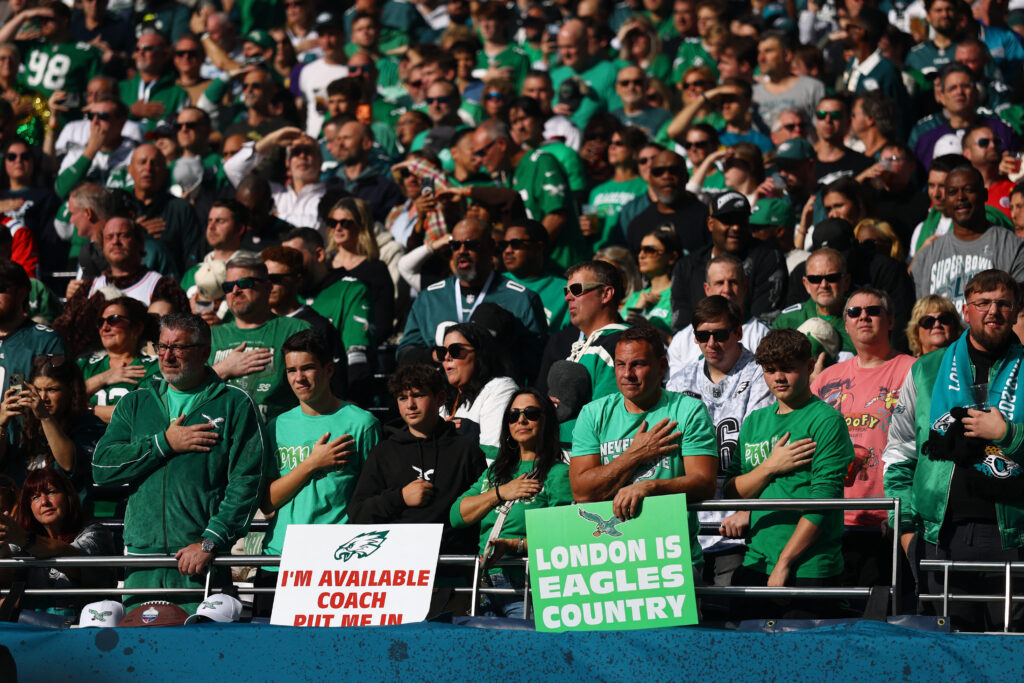
LONDON – The place had grown deafening. Two delay of game penalties for the Jaguars sandwiched around a false start reflected the kind of menacing, death-metal assault that has tormented the opposition for generations, across various Philadelphia venues, with victims from C.C. Sabathia to Tony Romo and the Boston Celtics.
Trevor Lawrence cupped the earholes of his helmet, a quarterback straining desperately to hear, the end zone fading further into the distance.
Only this wasn’t Lincoln Financial Field.
This wasn’t South Philadelphia.
This was Tottenham Hotspur Stadium. North London. Some 3,500 miles from Broad Street, where green had swallowed the place whole.
“I thought it was supposed to be a home game for us over here,” Lawrence said afterward.
He talked about how the Jags always have the stronger crowd in London. They put a stake in the ground here from the beginning of the NFL’s international push for manifest destiny.
Jags owner Shad Khan, in a bold and remarkably prescient attempt to grow a small-market team beyond its modest corner of northeast Florida, understood the possibilities of this city long before the rest of the league. He owned Fulham Football Club. He knew the market, the appetite, the opportunity.
For years, the Jaguars have cultivated London as their second home, turning a novelty into an identity. They weren’t simply exporting football. They were trying to claim a piece of the world.
The Jags weren’t merely visiting London.
This was their turf.
Until the Eagles arrived.
“Their fans were mental,” Jags kicker Cam Little said. “It was nuts.”
Everywhere you went in London this weekend, somehow everything led back to the Birds.
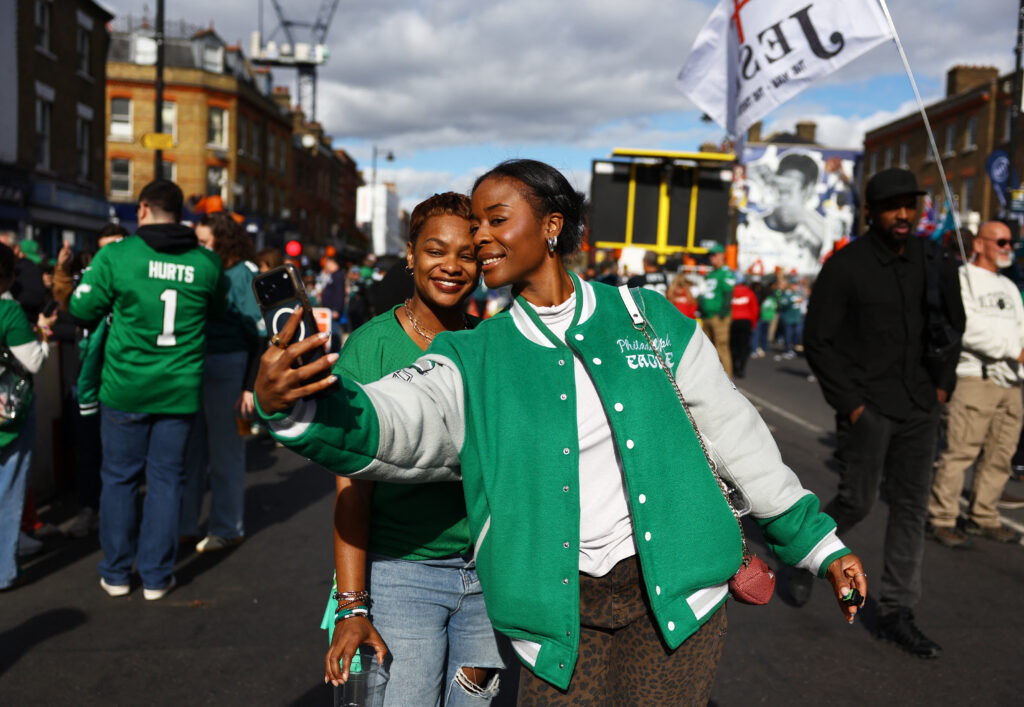
It started somewhere over the Atlantic on Thursday evening.
Thirty-five thousand feet above the ocean, and already there was no escaping them.
The first E-A-G-L-E-S chant erupted somewhere in the cabin, rolling through the rows of cramped seats, strangers connected by a shared obsession.
Meanwhile, the football team hadn’t even left for London yet. They were still tucked away at home, while their fans had begun the British Invasion.
They landed Friday morning and marched through customs at Heathrow Airport in their jerseys and hoodies, wearing their colors like battle flags, an invading army armed with rolling suitcases, duty free bags and an unshakable conviction that somehow, someway, they had come to claim London.
I remember the beginning. The infancy in becoming the World’s Team. December 15, 2003. A Monday night in Miami. The Eagles were finishing off the Dolphins at Pro Player Stadium when a celebrating, hooting mob dressed in midnight green began to make itself heard all over Monday Night Football. As victory became inevitable, the noise swelled. Everywhere I looked, there were Eagles fans. The only ones left. And the stadium belonged to Philadelphia.
By then, the Eagles had begun their ascent under Andy Reid, a transformation that was altering the very perception of a franchise long associated with losing. The bums. The punchlines. The perennial disappointments whose tortured history was littered with more heartbreak than glory.
But Reid changed that. The Eagles were no longer an embarrassment. They were contenders. Legitimate contenders. For the first time in what felt like forever, the faithful could realistically dream about a championship.
And it was as though the same idea had dawned on 20,000 people at once. Why not make a weekend out of it? A little pre-holiday jaunt to South Florida. Catch some December sun. Hit the beach. Throw back a few at the Parrot, the legendary Fort Lauderdale watering hole that had long served as a southern outpost for Philadelphians, replete with covers of the Daily News. Then head down to Miami on Monday night and watch the Birds, this team that had somehow transformed from a civic disgrace into a genuine Super Bowl threat.
Sunshine, cold beer and a football team that could actually win the whole damn thing.
What’s not to love?
And so they came. By plane, by car, in couples, in packs, entire contingents of friends and families. A traveling congregation of believers who had spent much of their lives suffering together and were now discovering the joy of taking their show on the road.
That night, as the Eagles were finishing the Dolphins, I caught my first glimpse of what this thing might become.
Twenty-three years later, the mob had crossed the Atlantic.
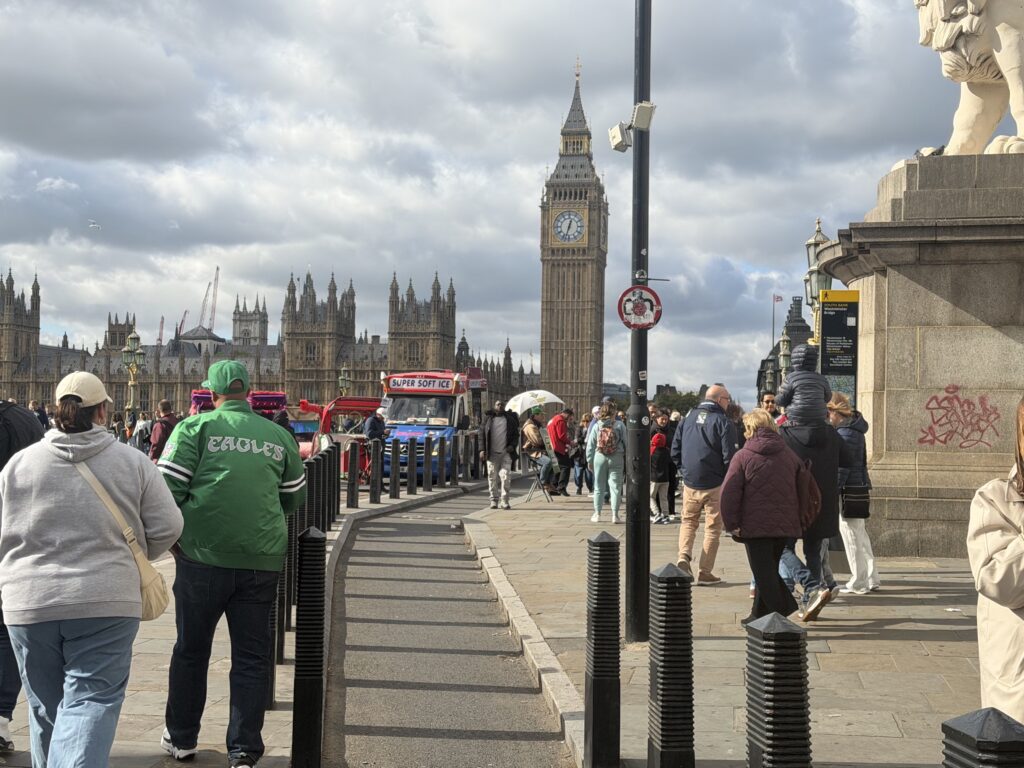
By Friday afternoon, the invasion had reached the banks of the Thames. Around London Bridge, where the city’s ancient streets wind between stone buildings. Railway arches and pubs older than the United States itself. The Eagles’ faithful were settling in.
They filled the taverns along the river, gathered outside with pints of lager and stout, their green jerseys standing out against the autumn English gray. The accents were unmistakable. Delco. Northeast. South Philly. Jersey. A little piece of Philadelphia had washed ashore in the old British empire.
The beer flowed. The stories grew louder. And every so often, from some corner of a pub or a cluster of fans gathered near the docks, came the familiar call.
E-A-G-L-E-S. EAGLES!
The chants would rise, gather a few more voices, then dissolve into laughter and another round.
There was something wonderfully absurd about the scene. Here, in a city that had endured Roman legions, Viking raiders and German bombers, came an altogether different breed of invader. Zealots of an American football team 3,500 miles away.
Unlike their predecessors, these invaders were welcomed at the pub.
Friday was merely the warm-up. Across the Thames, tucked in the railway arches of Waterloo, sat a place called Passyunk Avenue, an American-style Philadelphia bar that has become something of an embassy for expatriate Eagles fans.
On Saturday, it would become ground zero. A little slice of South Philly in the heart of London.
And the faithful were coming home.
By noon Saturday, the pilgrimage had begun.
The faithful poured into Passyunk Avenue at Waterloo, descending upon a labyrinth of railway arches transformed into something between a South Philadelphia corner bar, a shrine to the city’s athletic heroes and a museum dedicated to the peculiar religion of Philadelphia sports. There were televisions everywhere, old games playing, jerseys and flags and placards and T-shirts plastered across virtually every available inch of wall space. Stained-glass portraits of Bobby Clarke, Allen Iverson and Julius Erving. A Jason Kelce portrait in his Mummers costume. Upstairs, a room dedicated to Nick Foles, the unlikely Saint Nick who had delivered the city’s first Super Bowl championship and, in doing so, changed the emotional trajectory of an entire football franchise. There was even a batting cage. Because apparently, somewhere beneath the railway tracks of London, a man ought to be able to eat a cheesesteak, watch the Eagles and take a few hacks.
Only in Philadelphia.
Except this was England.
This was the creation of JP Teti, a South Philadelphia native who had taken a rather extraordinary gamble on the premise that what London needed was a little more Philadelphia. He originally envisioned an American sports bar built around the essential ingredients of the neighborhood corner joint, with cheesesteaks as the culinary centerpiece. But Teti’s ambitions were larger than simply exporting a sandwich. America, he reasoned, was a melting pot of wildly different cultures, an enormous country of 50 states with their own distinct identities. American culture in New Orleans bore little resemblance to American culture in Boston or Miami or Seattle. His contribution to this great international exchange would be unmistakably Philadelphian.
And so Passyunk Avenue was born, its name an homage to the crooked South Philadelphia street, particularly the section east of Broad that had evolved into one of the city’s most vibrant corridors, a collection of old-school neighborhood institutions and eclectic, award-winning restaurants serving a new generation of Philadelphians. Teti exported more than cheesesteaks and football. He brought along the neighborhood’s personality, its stubborn sense of self, its unvarnished affection for its own heroes and its apparently inexhaustible appetite for sports.
What began as one American-style bar has grown into five London locations, two in Waterloo, others in Fitzrovia, Kensington and Battersea, with expansion plans extending into Germany and Amsterdam. Somewhere along the way, Teti discovered that Philadelphia traveled surprisingly well. The first Super Bowl championship in February 2018 breathed new life into the enterprise, giving an already passionate community something it had waited generations to celebrate. The second championship, seven years later, only deepened the connection.
That was an essential ingredient in this remarkable transformation, one that cannot be overlooked in the romantic telling of the Eagles’ international ascent.
You have to win.
Preferably more than once.
Passion alone is not enough to become the World’s Team. The Bills Mafia have a wonderfully deranged, fiercely loyal traveling congregation, complete with its table-smashing traditions and lovable disregard for personal safety. But there is a difference between inspiring affection and inspiring mass identification. To transcend your local roots and become something larger, you need chips. You need the moments that become mythology, the heroes who become immortal, the victories that serve as permanent reference points for generations who weren’t even born when they happened.
Sports franchises are mirrors. Their triumphs become our triumphs, their failures an extension of our own frustration. We wear their colors and absorb their personalities, sometimes making them an irrationally large part of our identities. And while there is something noble about the lovable loser, the masses generally don’t want to look into the mirror and see a loser staring back, no matter how charming the poor bastard might be.
The Eagles had finally delivered the hardware. Twice.
And somewhere in the process, they had transformed from a franchise whose fans traveled well into one whose popularity seemed to know no borders.
By early Saturday afternoon, that transformation was on full display.
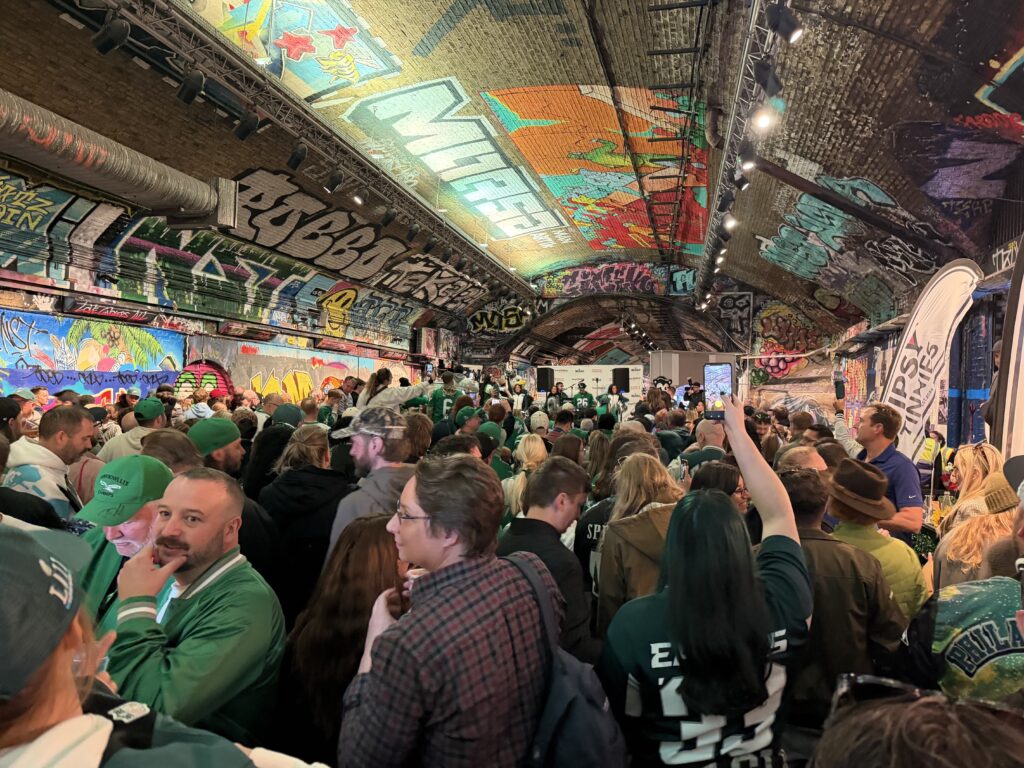
The party started at noon, an enormous pep rally staged with True Fan Travel, one of Passyunk Avenue’s travel partners. The faithful arrived in waves. Beer began flowing. Cheesesteaks smothered in Whiz and onions shared space along a long food table with chicken wings, hamburgers and hot dogs. It was an American football tailgate transplanted into the heart of London, with one small geographical inconvenience: the actual game was still a day away and several miles north.
The festivities spilled beyond the bar and into the railway arches, where an open-air canopy framed by graffiti-covered walls had become the staging ground for a full-fledged Eagles revival. Beer stations. More cheesesteaks. A DJ. A stage. People packed shoulder to shoulder, swaying, chanting, waiting for an assortment of visiting Philadelphia football royalty to appear. Darius Slay, the former Eagles cornerback, arrived holding hands with his wife, Jenny. Brian Westbrook was there, as was Jay Ajayi, the English-born running back who helped deliver that first Super Bowl championship. Eagles cheerleaders, Swoop and members of the organization’s corporate contingent mingled with the crowd.
There was something faintly ridiculous and thoroughly wonderful about it all. An American football pep rally beneath a London railway station, the surroundings possessing the industrial ambience of a Cold War bomb shelter, the air thick with beer, cheesesteaks and anticipation. Hundreds of people packed beneath the arches for what felt part rock concert, part religious revival. The chaos was somehow organized. Every pathway, every conversation, every fresh round of drinks seemed to lead back toward the stage.
And the congregation kept growing.
One of the men responsible for assembling it was Vince Rizzuto, who understood the economics of football fanaticism long before international sports travel became an industry unto itself. A decade earlier, Rizzuto had organized a single bus trip to an Eagles game in Washington under the banner of Philly Sports Trips. One busload of fans bound for an NFC East road game. Nothing especially revolutionary. Philadelphia fans had been traveling to opposing stadiums forever, though rarely with the kind of organization that could turn an ordinary road trip into a mass migration.
But Rizzuto saw the possibility. His company, now operating as True Fan Travel, had become an official travel partner of several NFL franchises, including the Eagles, Browns, Ravens, Seahawks and Falcons, along with Wrexham, the Welsh soccer club whose rise to international celebrity has become its own remarkable sporting story. The London journey marked the company’s 46th international trip. Rizzuto brought 250 travelers for this particular invasion, including 25 who would continue on to Italy. He said his international business has doubled annually for each of the previous three years.
There was clearly money to be made in moving the faithful. But Rizzuto was selling something more than plane tickets and hotel rooms. He provided the coaches and horses for the takeover, assembling an army of strangers whose shared allegiance made them instant companions. The previous year, more than 1,000 Eagles fans had followed his operation to Washington, helping transform Northwest Stadium into what visitors began calling Lincoln Financial Field South. Earlier this season, another 900 had made the journey to Nashville.
“Ten years ago it was one bus to Washington,” Rizzuto said. “This week it’s 250 fans in London and 25 of them heading on to Italy. The plan is working.”
But the most fascinating element of the scene wasn’t merely the remarkable number of Philadelphians who had crossed an ocean to see their football team. Nor was it the expatriates from Florida, California, Texas and throughout the Midwest who had once called Philadelphia home and now used the Eagles as their enduring connection to the city they had left behind. There were fathers and sons, husbands and wives, groups of buddies and girls’ trips, entire contingents of friends reconnecting around a team that had given them a common purpose.
That was impressive enough.
What had become even more extraordinary was the growing number of people who had no ancestral claim to Philadelphia whatsoever.
British fans. Irish fans. Members of Eagles supporters’ groups from Germany and Italy. Men and women from across Western Europe who had somehow found their way to this strange American obsession and made it their own. They weren’t merely visiting Philadelphia’s party.
They belonged to it.
And in some cases, they had been there almost from the beginning.
I had watched this phenomenon develop over the course of two decades, beginning around that Monday night in Miami in 2003, when the traveling community was largely composed of displaced Philadelphians and their friends. As the world grew smaller, as the internet eliminated borders and technology allowed an Irish schoolteacher or a basketball fanatic in England to listen to Philadelphia sports radio in real time, the community expanded into places I never would have imagined.
The calls started coming from everywhere.
There was Andy in Mumbai, India, who would watch Eagles games inside a closed bar at some godforsaken hour, then call my radio show to discuss the Birds as though he were sitting in a Northeast Philadelphia corner bar. Andy survived a bombing aboard a Mumbai commuter train, a terrifying brush with mortality, yet somewhere in his remarkable life he had found room to join the Eagles flock.
There were callers from Australia, Indonesia, Hawaii and remote outposts across Europe, voices arriving through the telephone lines from places thousands of miles removed from Broad Street. They spoke with different accents, lived in different cultures and followed the games at hours that suggested a fairly serious disregard for their own sleep. Yet there was always the same excitement, the same eagerness to belong, the same wonderfully familiar declaration of loyalty.
There was Aiden, a schoolteacher in Dublin who had fallen in love with Philadelphia sports and eventually made the trip to the city with his uncle. He became a regular presence, part of this improbable international family, and like so many Irishmen I’ve encountered, proved to be a magnificent storyteller. Among his favorite subjects was Gerard “The Monk” Hutch, the notorious Dublin underworld figure long associated with some of Ireland’s most audacious robberies and organized-crime feuds.
One day toward the end of May, a message arrived from Aiden.
He was on Lanzarote, the Spanish island off the African coast, when he encountered something apparently too good not to share.
“Guess who I just met?”
Gerard Hutch.
There was The Monk, drinking with Aiden’s neighbors.
Aiden walked over, shook his hand and cheerfully greeted him.
“Hi Gerry.”
Only afterward did he remember that Hutch despised being called Gerry.
Somewhere in the Canary Islands, one of my Irish Eagles correspondents had managed to stumble into a real-life gangster movie. It seemed an entirely appropriate development for this bizarre international fraternity.
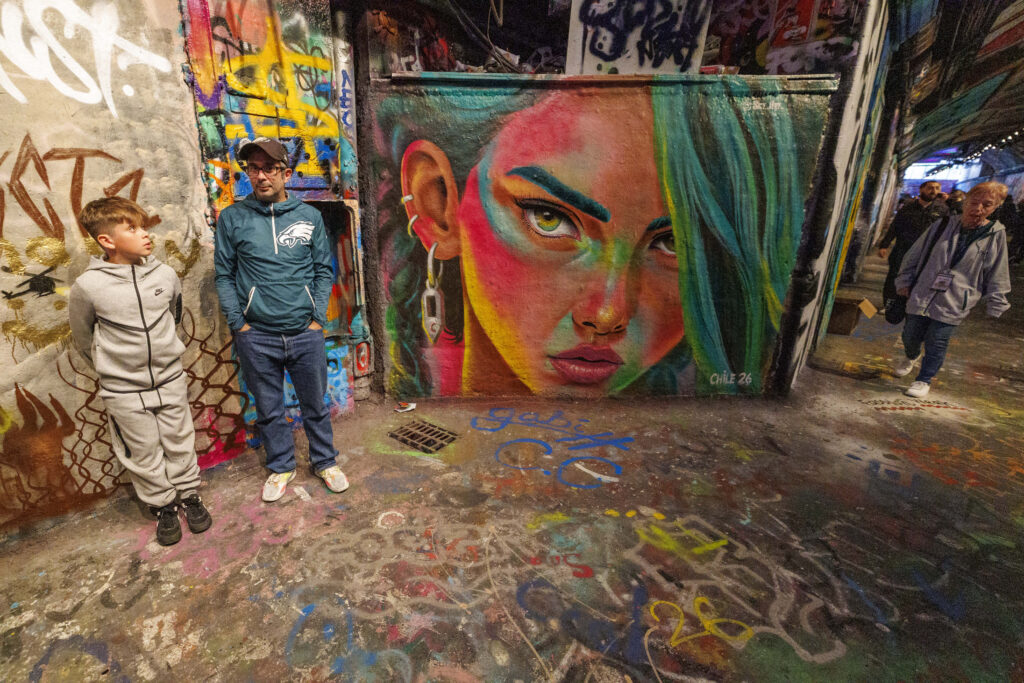
And then there was Sam Oakley-Aslet.
Sam came from Winchester, roughly 90 minutes southwest of London, and had become a fixture in my world sometime in the middle of the 2010s. A friend as much as a listener, he began as a diehard Sixers fan, one of those wonderfully obsessive basketball junkies who could carry on an argument about the virtues of a backup point guard for an unreasonable amount of time. His love of Philadelphia basketball ran so deep that he named his first son Iverson and his third Joel. The middle boy was named in honor of his brother, who had been stillborn. Otherwise, Sam said, the boy would have been Charles.
As in Barkley.
Consider that for a moment.
A man from Winchester, England, naming his children after the heroes of a professional basketball franchise in Philadelphia, Pennsylvania. Allen Iverson and Joel Embiid had somehow become part of one English family’s history.
You cannot manufacture that kind of loyalty with a marketing campaign.
Sam and his friend Ben Scaife, another basketball obsessive, formed a Facebook community called UK Sixers, eventually connecting with Liam O’Neill, Phil Mountstephens and Dave Shaw of UK Phillies. Together, they helped develop a growing network of Philadelphia sports followers across Britain and Ireland. What had begun with separate allegiances to basketball and baseball evolved into a broader community connected by the peculiar emotional frequency of Philadelphia fandom.
And now here they were, reunited beneath the railway arches at Waterloo, surrounded by hundreds of others who spoke their language.
Not necessarily the English language.
The Philadelphia language.
Ben sat quietly sipping his pint while Phil, wearing a midnight-green Jason Kelce jersey, considered what had happened to American football fandom in Britain. He had watched the overseas following grow and develop, seen different NFL franchises attempt to plant their flags across the United Kingdom. But he regarded the Eagles’ following as something unique.
“This is where the OGs are,” Phil said. “I’m so proud and fortunate to be an Eagles fan. Fate made me an Eagles fan and I’m grateful. No other fan group has the passion that we do. Eagles fans dominate all NFL fans over here.”
Liam, who is Irish, believed there was an obvious cultural connection between Philadelphia and this part of the world.
“It’s the sporting culture,” he said. “It matters there the way it does here.”
It was a wonderfully simple explanation of something that American sports executives have spent considerable time and money trying to understand.
In Philadelphia, sports aren’t merely entertainment. They are a family inheritance, a civic obligation, an expression of neighborhood identity. Wins and losses become part of the rhythm of daily life. Arguments over coaches and quarterbacks carry the intensity of political debates. The games provide a shared language between people who might otherwise have very little in common.
It isn’t so different in England, where football rivalries can divide families, neighborhoods and entire towns, often carrying grudges that predate the birth of the people screaming at one another.
Sam understood that instinctively.
His English soccer allegiance belonged to Southampton, whose bitter rivalry with Portsmouth, the South Coast Derby, had been renewed on the very weekend of Eagles-Jaguars. Naturally, he offered the comparison most likely to resonate with a visitor from Philadelphia.
“It’s like Eagles-Cowboys.”
Only with a considerably longer historical grudge and, on occasion, a level of hostility that makes the parking lots at Lincoln Financial Field seem like a church picnic.
Sam sent me a video from an X account devoted to “football fights,” showing Portsmouth supporters and police in a tense standoff after barriers designed to separate rival fans had been breached. The rivalry had become so volatile that authorities had reportedly committed 400,000 pounds to maintaining order for this one match.
There was something hilariously instructive about an Englishman explaining the cultural significance of Eagles-Cowboys by invoking a rivalry that required a police operation to keep the peace.
These were my people.
Sam, meanwhile, had long since graduated from following Philadelphia sports at a distance. He had made at least eight trips to the city by his own count, attended roughly 30 Sixers games and four Phillies games, and arranged his travel around some of the most important moments in recent Eagles history. He had been there for the last three Super Bowl appearances, including the championship parade following the Birds’ second title.
He worked in the financial sector, and when his position was recently eliminated, he accepted a buyout before beginning a new job. Rather than simply bank the money, he used part of it to make another pilgrimage to Philadelphia with his oldest son. There was the World Cup and there were the Phillies, legitimate sporting attractions that offered convenient explanations for the journey.
But the real purpose was more personal.
He wanted to show his boy the city he loved.
A city on another continent. A city where he had never lived. A city that has nevertheless become an essential part of who he was.
And watching Sam at Passyunk Avenue, surrounded by the friends he had accumulated through this remarkable sports community, I couldn’t help thinking about how dramatically the definition of a Philadelphia fan had changed.
It once meant where you came from.
Now it could mean what you chose to love.
Outside, the celebration rolled on.
The DJ worked the crowd, the beer kept flowing and the chants echoed beneath the railway arches. A little English reserve had long since surrendered to the full-throated Philadelphia experience. Teti had turned his unlikely American export into an institution, a meeting place for the homesick and the converted, a kind of unofficial embassy for anyone whose emotional compass pointed toward Broad and Pattison.
He had another attraction planned: a double-decker bus tour through London with Eagles representatives tossing cheesesteaks to the public, an image so absurdly American that it felt almost like performance art.
Philadelphia had exported its food, its sporting heroes, its peculiar sense of humor and its gloriously unreasonable expectations.
London embraced the package.
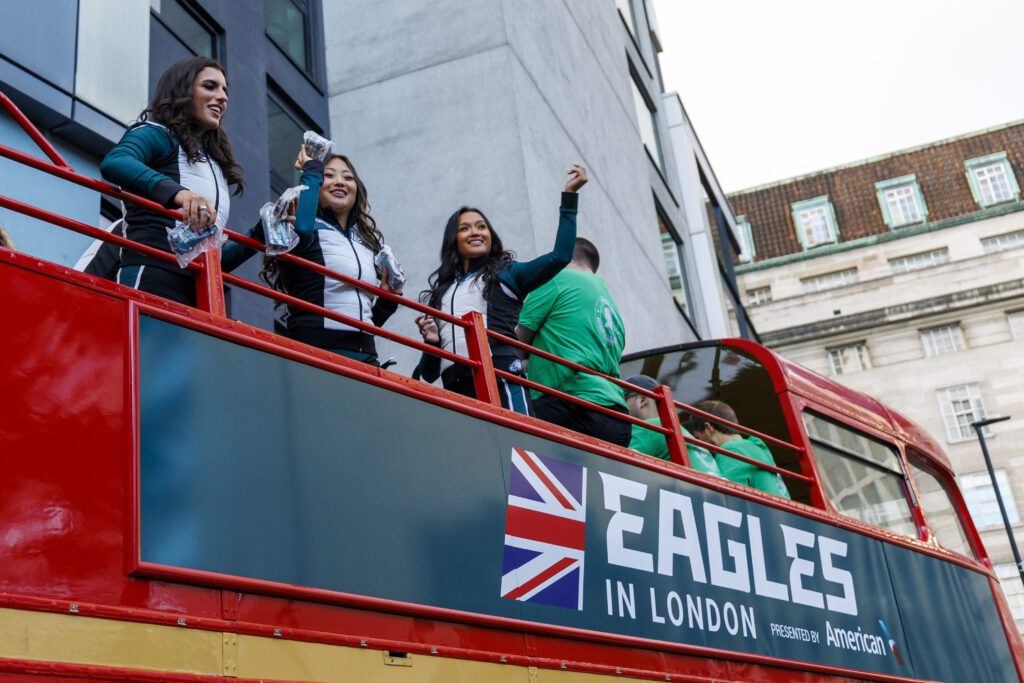
Teti estimated that more than 25,000 people would pass through his Eagles-related festivities over three days, culminating in a Monday celebration dubbed a victory parade, a rather optimistic designation given what would ultimately happen on the field.
But that was the thing.
The weekend had become bigger than the game itself. By Saturday night, the faithful had dispersed across London, carrying their party into a city already expert in the art of spectacle.
In the West End, amid the theater crowds, restaurants and pubs, green jerseys and Eagles hoodies became part of the nighttime landscape. Around Piccadilly Circus, where enormous illuminated signs competed for attention above the crowds and London’s endless procession of visitors moved through the streets, the Philadelphia contingent seemed almost perfectly at home. They were loud, certainly. Occasionally ridiculous. Often fueled by pints of beer and the exhilaration of being thousands of miles from home.
But London barely blinked.
This was a city that has seen everything, a place accustomed to eccentrics, revelers, performers, foreign visitors and people whose wardrobes required no further explanation. A few thousand Americans clad in jerseys and periodically shouting the spelling of their favorite team’s name hardly qualified as a civic disturbance.
They blended beautifully into the madness.
The invasion reached even the most unlikely corners of the city.
Late that night, deep in London’s Chinatown, where a dim sum restaurant was still serving food, there he was in a back corner.
Sean from Delco.
Baseball cap turned backward. Eagles jersey. Sitting with three British mates, apparently enjoying a perfectly ordinary night out in one of the world’s great cities.
Until he spotted another member of the congregation.
“GO BIRDS!”
There it was. That unmistakable Delaware County ohhh, the vowel stretched into a geographical identifier so precise that it might as well have carried a postal code.
It didn’t matter whether you were beneath the railway arches of Waterloo, outside a theater in the West End or eating dim sum in Chinatown at an ungodly hour.
Somehow, someway, the Birds would find you.
And they weren’t finished.
Sunday morning brought Warren.
He was waiting outside the DoubleTree Hotel in his London black cab, a stout, thick man with a round, kindly face, the sort of bloke who looked like he had spent a lifetime navigating the city’s traffic and listening to the peculiar problems of humanity from the front seat.
I was headed to the media hotel to catch a shuttle to Tottenham, a relatively ordinary assignment for a London cabbie on an NFL Sunday.
Or so I thought.
“Here for the American football, mate?”
Yes.
And just like that, Warren was off.
He loved American football. Loved the Eagles. Loved American culture and the whole sprawling, wonderfully excessive universe that came with it. He told me how he had discovered the sport, chosen Philadelphia as his team and developed the kind of allegiance that seemed improbable for a man whose daily commute took him through the streets of London rather than down the Schuylkill Expressway.
Another convert.
Only Warren came with an unexpected cultural bonus.
He adored The Sopranos. He had become friendly with Steve Schirripa, the actor who played Bobby Baccala, during a London appearance with Michael Imperioli, better known as Christopher Moltisanti.
Here was a London cabbie who had somehow connected with the fictional mobsters of North Jersey and the real football fanatics of South Philadelphia.
Naturally, I told him about my own affection for British gangster movies and Warren seemed delighted.
Because, as it turned out, he had a few stories of his own. Two of his aunts, he explained, had married bank robbers. Not metaphorical bank robbers. Actual bank robbers.
One was known as the Chopper, a criminal whose specialty involved trapping armored trucks in tunnels and sawing into them to steal the contents. It was the kind of elaborate operation that sounded as though it had been developed over several pints in a London pub and then somehow made it into production.
The Chopper had also devised a scheme to steal an airplane that periodically transported Scottish banknotes.
Because why rob a bank when you could simply steal the bloody delivery system?
The scheme failed. He was caught.
The other aunt’s husband wasn’t as bright. “He was a pistol man,” Warren said.
The entire weekend possessed a slightly cinematic quality, thousands of Philadelphians invading London, pints and cheesesteaks flying through the air, an Irish schoolteacher encountering a notorious Dublin gangster on a Spanish island and now a British taxi driver casually unveiling a family tree populated by armed robbers.
Guy Ritchie couldn’t invent this stuff.
Somewhere beneath the outrageous stories, though, Warren represented the very thing that made this journey so fascinating. He wasn’t a displaced Philadelphian trying to maintain a connection with home. He wasn’t a traveler who had attached himself to the Eagles because the team happened to be winning.
He had discovered an American sport, fallen for its peculiar rhythms and violence and drama, and then chosen a team that somehow spoke to him.
A Londoner whose football heart resided in Philadelphia.
And I was discovering that there were a hell of a lot more Warrens than anyone back home might have imagined.
The media shuttle deposited us near Tottenham in a construction area crowded with buses, an unceremonious arrival that seemed entirely out of proportion to the enormous spectacle awaiting us.
We stepped into a pit of gravel and concrete blocks, picking our way through the makeshift surroundings toward the neighborhood streets. There was a money exchange storefront to the left, a Middle Eastern fast-food joint and the ordinary commercial clutter of a working North London neighborhood.
And then, rising above it all, came the stadium.
Tottenham Hotspur Stadium.
What a place.
There is something about a great urban sporting venue, the ones that seem to rise out of the fabric of a neighborhood rather than occupy their own isolated kingdom of asphalt and parking lots. Wrigley Field on Chicago’s North Side has always possessed that magic, tucked into the old brick-and-stone neighborhood of Wrigleyville, where the ballpark and the surrounding streets have become inseparable parts of the experience.
Tottenham possesses a version of that same intimacy, albeit on a much grander and more modern scale.
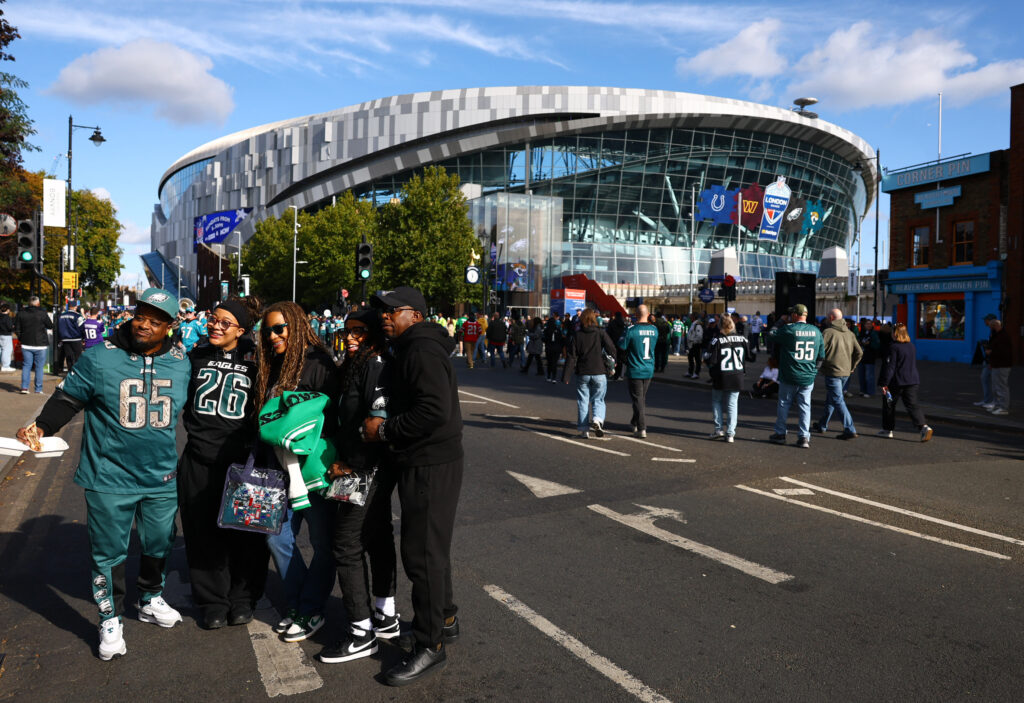
The stadium, which opened in 2019 on the site of the old White Hart Lane ground, is a magnificent monument to contemporary sporting architecture, all sweeping steel and glass, towering grandstands and an almost theatrical sense of scale. Its capacity of 62,850 makes it the largest club stadium in London, a gleaming cathedral built in the middle of a living, breathing neighborhood. The surrounding High Road isn’t some sterile development designed to accommodate a sports venue. It is a busy artery of North London, with its shops and restaurants, old buildings and everyday commerce. The stadium simply rises above it, an enormous futuristic structure embedded in the life of the streets around it.
And on this Sunday, those streets belonged to Philadelphia.
The road directly in front of the stadium had been surrendered to pedestrians, and everywhere I looked there were Eagles fans. Not merely midnight green, but every shade of green the franchise had worn over generations. Kelly green throwbacks, the darker modern jerseys, hoodies and jackets, old names and new heroes, different eras of Philadelphia football history converging on one North London street.
The faithful were holding court outside the pubs, pints in hand, laughing and shouting and exchanging the familiar greetings of a fan base that had somehow transformed the world into one enormous neighborhood.
Go Birds.
There were clusters of fans gathered beneath storefronts, others standing in the streets, people pausing for photographs, trading stories about their travels and the latest state of the team. The noise spilled down the pedestrian thoroughfare, the chants rising from one group and being answered by another.
This wasn’t the antiseptic international marketing event the NFL might have envisioned when it first began planting its flags overseas.
It felt like Sunday in Philadelphia.
Only the architecture was different.
And as imposing as Tottenham Hotspur Stadium appeared from the outside, the experience became even more remarkable once inside. The playing surface sits within a sharply raked bowl designed to pull spectators close to the action, the stands rising steeply around the field rather than stretching endlessly away from it. The massive single-tier South Stand, capable of holding 17,500 supporters, towers above one end, an architectural wall of humanity built with the intention of capturing and amplifying the ferocious atmosphere of English football.
Unlike so many modern American stadiums, where luxury suites and sprawling concourses can sometimes dilute the intimacy of the experience, Tottenham seems designed to concentrate the crowd’s energy, to make a stadium of more than 60,000 feel like one connected organism.
It is, quite simply, one of the great modern sporting venues.
And on this particular Sunday, it was preparing to become a Philadelphia home game.
The stands filled slowly at first, pockets of green appearing across the seating bowl, then expanding, connecting, swallowing the empty spaces.
Down on the field stood Dom DiSandro, Big Dom, in his gray Eagles sweatsuit, talking with Ndamukong Suh, the enormous defensive tackle who once tormented the NFL. Dom lamented the extraordinary number of injuries that has afflicted the team and joked of Big Suh suiting up.
It was the kind of gallows humor familiar to anyone who has spent enough time around an NFL team, where the injury report can sometimes resemble a hospital census and yesterday’s retired veteran stars look like tomorrow’s emergency roster solution.
But above them, the mood was considerably more festive. The noise grew as kickoff approached.
The chants began rolling around the bowl, gathering strength as the last of the fans found their seats. Here and there were a few tiny pockets of Jacksonville fans. But they became isolated islands in an enormous Philadelphia ocean.
For all of Shad Khan’s foresight, for all the Jaguars’ years of investment in London, their adopted home had been commandeered by the visitors.
The Eagles fans had flown across an ocean, taken over the pubs, filled the railway arches of Waterloo, spilled through the West End and Chinatown, embraced their British and European brethren, and marched into one of the most magnificent stadiums in the world as though they had been doing this every other Sunday for the past hundred years.
They had arrived from South Philadelphia and South Jersey, from Delco and the Northeast, from Florida and California and Texas. From Winchester and Dublin, Germany and Italy, and places where the only connection to Philadelphia existed through a television screen, a radio broadcast or an inexplicable love affair with a football team in another country.
The pilgrimage had reached its destination.
And as the sound continued to build, as the last few minutes before kickoff slipped away and the stadium became a roaring mass of green, the full magnitude of the transformation was impossible to ignore.
Twenty-three years earlier, I had watched the Eagles finish off the Miami Dolphins and heard a traveling mob discover the intoxicating possibility of turning an opponent’s stadium into its own.
Now that mob had crossed the Atlantic.
The Jaguars had spent years trying to make London their second home.
The Eagles had needed only one weekend.
The takeover was complete.
The Cowboys were America’s Team, a creation of another century, when television became the great national campfire and the NFL was exploding into the country’s most powerful cultural institution. They were glamorous and successful, their star shining from coast to coast, an empire built on winning and marketed with the precision of Hollywood.
But that was the 20th century.
The Eagles belong to something different. A smaller world. A connected world. A world without borders, where a kid in Mumbai or a cabdriver in London can fall in love with a football team from a city he’s never visited. Where an Englishman names his sons Iverson and Joel, where the old neighborhood allegiances of South Philadelphia can somehow stretch across oceans and cultures.
The Cowboys were America’s Team.
The Eagles have become the World’s Team.
And yet, beneath the extraordinary spectacle of London, there was a troubling irony. At the very moment the Eagles’ reach had never been greater, the team itself is approaching an uncertain future. At 2-3, a franchise that has become the model of sustained success is suddenly wobbling, its quarterback and head coach facing difficult questions, its foundation showing cracks that even the most magnificent traveling congregation couldn’t disguise.
Howie Roseman has never been afraid to tear down something that no longer works. Change is part of his DNA. The Eagles have reinvented themselves before, sometimes brutally, and there is reason to wonder whether another reckoning awaits.
What happens then? What happens if the architects of this latest golden age are gone? If the winning that helped transform a regional obsession into a worldwide movement becomes harder to sustain?
The Cowboys offer a cautionary tale. America’s Team became a brand so powerful that it outlived its championship years, its enormous following persisting even as the trophies stopped coming.
Perhaps that is the final measure of what Philadelphia has become. The Eagles no longer belong exclusively to Philadelphia. They belong to Sam in Winchester, Warren in London, Andy in Mumbai and thousands of others who have adopted a city and a team as their own.
The players will change. The coaches will change. Even the winning will come and go.
But the faithful?
They’ll keep coming.
By plane, by train, by black cab, from South Philadelphia to South London and wherever this strange, magnificent obsession takes them next.
The world is green.

2 Comments
David
Fantastic article. As an Eagles fan and a Londoner, Sunday will live long in the memory.
Charley Pritchard
Amazing! I live in London and I was sitting in the South stand, that goal line stand is one of my greatest sporting experiences despite the result. The article perfectly portrays why I love Philly. It’s more than just a game.