© 2026 ALLCITY Network Inc.
All rights reserved.



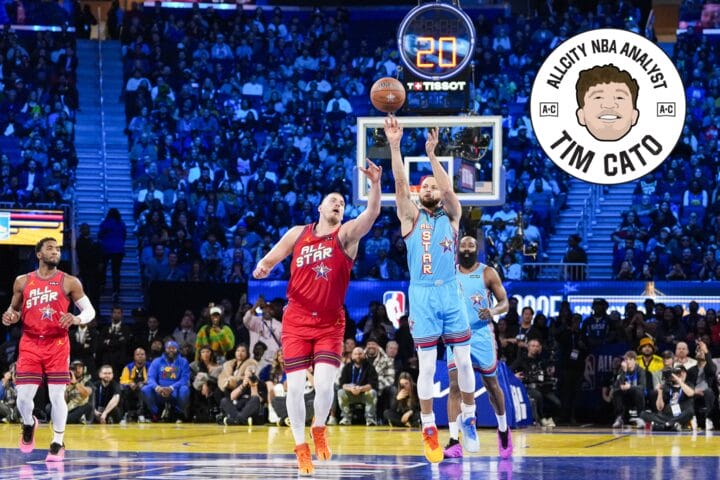
The NBA will announce this year’s All-Star starters later this Monday; the reserves will wait until next week ahead of the Feb. 15 game in Los Angeles. I’ve served as one of the league’s voters in the past, but I’m not one this season. Thus, this is a wholly unofficial ballot, one which just stands as my record of the league as I’ve seen it this season. So fight me on these picks, but don’t yell too loud. It’s the coaches who pick the bulk of the roster, anyway.
For better or worse, there are two notable changes to this year’s format: First, this year’s ballots are wholly positionless. That’s straightforward. Second, this year’s All-Star Game will be played between three eight-man squads: Two made up of Americans; one composed of international players. It will be a round robin tournament, and additional American or international players will be added if there are fewer than 16 Americans or eight internationals. (Here’s the NBA’s explainer for more context.) In my ballot’s case, I was one short. We’ll sort that out at the end.
Briefly, on my methodology: I watch the entire league, and aim not to go more than two weeks without catching any given team at least once. The eye test matters. So do counting stats, advanced metrics, and a player’s on-off numbers. That last one, in particular, you’ll see me reference a lot. When used correctly, I value it as strongly as any almost other stat. There’s loads of needed context to those splits, of course, which is why Jamison Battle sadly isn’t one of my selections despite him grading out best. Next year, Jamison. I have no exact rubric, but these ballots were chosen through an amalgamation of those four benchmarks, if you will, with team record as an important context provider that can eliminate or break ties but not necessarily elevate players above what they’ve done.

This column has thorough explanations for my choices, but not expansive ones. If you’d like to hear me expound on these justifications, please shoot me an email (tcato@alldlls.com). For nearly every sentence written, there are several paragraphs I’ll happily write later this week about how I reached these stances. These things are meant for some friendly sports debate, after all.
WESTERN CONFERENCE
STARTERS (*locks)
*Shai Gilgeous-Alexander
*Nikola Jokić
*Luka Dončić
*Victor Wembanyama
Stephen Curry
The asterisked players hardly need their cases made for them. Oklahoma City’s slight dip in form, to me, puts to rest any hyperbolic idea that the Thunder could be two 60-win teams if you split their roster in half. Gilgeous-Alexander is the overwhelming reason this offense isn’t bang average. Jokić is the league’s best player; Dončić remains firmly top-five, and the extensive debates about his flaws, of late, have overly minimized how great he remains. (The Lakers are a top-five offense in his minutes on the court; they’re bottom-five without him.) Wembanyama is the most impactful defender in league history with incredible, if inconsistent, offensive peaks.
It’s the Western Conference’s fifth starter, alone, that merits debate. I narrowly awarded it to Stephen Curry, who’s having his highest scoring and most efficient season of the past three years. I must emphasize how offensively inept this Golden State roster would be without him, how much they still, after all these seasons, cannot function without the unprecedented fixation he forces upon opponents. In the minutes without him this season, the Warriors score just 108.5 points per 100 possessions, which would comfortably be the league’s worst mark. He of course leads the league in the NBA’s gravity metric by a mile. I’ve long felt Curry’s post-prime has been undervalued; while his last two seasons wouldn’t have put him among his conference’s top-five, this one deserves these plaudits.
It was still incredibly difficult to not award Anthony Edwards, whose role as Minnesota’s alpha shotmaker makes them feared. When he’s on, he might be the league’s least guardable player, and he’s been that more often this season than any prior. (His 63.1 percent True Shooting this year is easily his career best.) If his defense and creation matched prior seasons, he’d have an airtight case. His surprisingly low on-off numbers suffer from lineup composition choices; Chris Finch asks him to lead bench units while clumping the team’s other starters together, and Edwards alone can’t change how much the defense suffers in his minutes without Gobert. But these reasons were enough for me to hand the fifth starting slot to Curry even if I’m empathetic to anyone who would reverse that choice.
Kawhi Leonard’s case, perhaps surprisingly, came next closest for me. Both the volume and efficiency of his scoring this season has been nearly identical to Edwards’ — 28.2 points on 63.3 percent True Shooting — with a more visible defensive effect. But L.A.’s disappointing season and Leonard being slightly less available scuttled any idea he should start the All-Star game hosted in his home arena.
Neither Jamal Murray and Kevin Durant, both All-Star locks, had arguments quite compelling enough to consider them for the fifth starter slot.
RESERVES (*locks)
*Anthony Edwards
*Kawhi Leonard
*Jamal Murray
*Kevin Durant
Chet Holmgren
Devin Booker
Deni Advija
Murray still appears set to finally earn his first All-Star nod; his candidacy is airtight as he’s led the Nuggets to punch far above expectations in Jokić’s recent absence. He has career bests in scoring, assists, 3-point percentage, and True Shooting percentage. That’ll do it. As for Durant, in addition to how typically brilliant he’s been, it should be noted he’s averaging the third-most minutes in the entire league. He’s been sneakily good as a rim protector, too. To put it another way: In another season or another conference, both would be deserved starters. But, alongside Edwards and Leonard, they’re write-’em-in-pen, no-questions-asked All-Stars.
That leaves three slots. Holmgren has been the league’s best non-Wembanyama paint defender and the second-best player on the league’s most outstanding team. It probably helps that there is little debate about the latter thanks to Jalen Williams’ quieter year, but Holmgren has earned his inclusion even if he’ll be the least impactful offensive player awarded. His counting stats are a bit low to view him as a nailed-on lock; everything else merits it easily. Devin Booker must be here, too. This isn’t his best scoring season, nor his most efficient, but he’s still the best player on the league’s most surprising team. His inside-the-arc isolation scoring is a perfect synergistic mesh with Phoenix’s identity; they couldn’t operate this way without it. This also ensures the West’s top-eight seeds all have representatives, which isn’t necessary but feels right.
The West’s final spot goes to Advija. First, here are the other players considered, some more deeply than others, for the 12th man role.
HAD CASES: Alperen Şengün, Dillon Brooks, Jimmy Butler, James Harden, Rudy Gobert, LeBron James, Lauri Markkanen, Austin Reaves
Şengün came closest to overtaking Advija; too often, he’s the Rockets’ only hope to dig out a useful shot amidst his team’s sluggish spacing. Butler has been far more effective than his counting stats give him credit for; estimated plus-minus, which has always loved him, ranks him among the league’s top-15. Minnesota’s defense crumbles without Gobert. Harden is having his best scoring season since his last full year in Houston, and he’s been efficient, too. Markkanen has been wonderful even while his team has not. Reaves and James’ cases would be stronger, although certainly not airtight, if they had played more games. And Brooks at least merits this name drop.
But Advija deserves this nod. When he’s off the court, Portland averages 101.5 points per 100 possessions. That would be a below-average offense in each of the league’s past 48 seasons. I’m not joking: The last time the league’s average offensive rating was lower than that figure was the 1977-78 season. Portland’s guard injuries have amplified this, of course, but Advija’s scoring (26.5 points per game) on above average efficiency is too often the only thing saving the Trail Blazers from truly abysmal levels of incompetency.
Lastly, just for fun, here are four more names whose candidacies were closer to that list above, when reviewing advanced metrics and my eye test, than I’d have ever expected when this year began: Colin Gillepsie, Donte DiVincenzo, Isaiah Hartenstein, and, when briefly healthy, Zach Edey. (These aren’t the next four up after those names above, to be absolutely clear, but they’re in the same bucket of players that missed the just-missed list.)
EASTERN CONFERENCE
STARTERS (*locks)
*Giannis Antetokounmpo
*Cade Cunningham
*Jalen Brunson
Tyrese Maxey
Donovan Mitchell
Antetokounmpo remains the East’s best player. Cunningham drives Detroit’s offense, often alone, and might be the league’s best defensive superstar. Brunson certainly isn’t that; what he contributed to the team’s defense, or rather what he hasn’t, is concerning. But, come on, let’s not go crazy: He’s a gamer, he’s the league’s eighth-leading scorer, he’s the team’s heart. I did waffle on considering him a starting lock; his herky-jerk tempo isn’t always a good match for Karl-Anthony Towns, although that’s not really his knock but his team’s. Ultimately, his case is clear enough, for me, that I asterisked him in pen.
We now need two more names. Tyrese Maxey, the league’s third-leading scorer, should get one of them. No player in the league moves like him; players as fast, if there are any, don’t have his same shimmy-shake hesitation. They can’t explode like he does when he shapes like he’s about to shoot. They don’t take that unexpected extra dribble that so often propels Maxey from 20 feet out to having both feet firmly planted in the lane. He leads the league in minutes, too, which does matter to me. I feel the need to make his case; I suppose that means he can’t be a lock. But I feel so strongly about his inclusion that he might as well be.
Donovan Mitchell nabs the final spot over Jaylen Brown, which surprised even me. Both have undisputed All-Star cases, and I went into this expecting to award this to Brown, whose team has obviously been better. But Mitchell carries no blame for Cleveland’s disappointing start, and the Cavaliers’ recent surge has them just three games behind Boston. This is Mitchell’s best scoring season and most efficient one, too. When he’s been on the court, Cleveland has been the same dominant force it was last season, outscoring opponents by eight points per 100 possessions. You’re welcome to ping him for what Cleveland has done whenever he sits; the team’s minus-121 without him this year is horrific. I’m not, and putting him in with the starters.
It still hurts to leave out Brown, who’s been comparably excellent. I just don’t see him as the driving force behind Boston’s surprising success, but rather the leading one alongside several spectacular seasons from his teammates. There’s another Celtics player on this list; Cleveland didn’t even come close to a second. None of this reasoning is meant to dismiss what Brown has done; the Celtics wouldn’t be here without his career bests in points and assists. Like Phoenix, what he does in the mid-range feeds perfectly, and necessarily, into Boston’s possession-winning machine. Even then, I’d still have had these two players flipped even a few weeks ago, but the records have narrowed too much to consider that a viable tiebreaker.
RESERVES (*locks)
*Jaylen Brown
*Scottie Barnes
Michael Porter Jr.
Derrick White
Jalen Johnson
Norm Powell
Jalen Duren
Brown leads the reserves list for all the reasons above. Barnes is another lock; he’s the only starter whose absence causes Toronto to lose its minutes. Yes, he’s a shade under 20 points per game, but his offensive malleability does so much for his teammates and he’s never been this efficient. Add to that his plus-plus defense, and he’s the clear driving motor behind Toronto’s success even while acknowledging there’s plenty of credit to be spread around.
I don’t believe the next four players have airtight, can’t-be-argued cases, particularly in the grander context of who should earn All-Star spots. The cases for all four have blemishes: Porter and Johnson’s are their teams records, both under .500; Powell’s is his one-dimensionality; and White’s is his shooting percentages. With that said, these four players, in my eyes, have cases that exceed this conference’s other candidates.
Johnson absolutely stuffs the box score. (He’d stuff the horrific monstrosity of a box score I created, too.) I’ve been cooler on the “emerging superstar” narrative thrown around him this season than some; I’m not convinced he’s a sure bet to soon be a top-10 player. I am convinced, however, he’s an exceptionally good one, which I’ve believed since his pre-injury emergence last season. Johnson’s feel is ridiculously good; he swings bullets around the court with both hands and has touch on the stuff inside. His 3-pointer and ability to draw fouls has improved. He’s maintained how often he gets to the rim, is finishing once there better than he ever has, and has heaped more mid-range responsibilities atop that while increasing his overall efficiency. It’s come at the expense of his defensive effort, but that’s far more a disappointment than a knock for this ballot.
Porter’s another near-lock despite Brooklyn’s record. The Nets are a bang average team when he plays; they’d have the league’s second-worst point differential without him. That’s because Porter, in my eyes, has been the league’s second-best shooter past Curry. He takes the most contested 3s in the league — and, per tracking data, it isn’t close — and still converts nearly 41 percent of them. He’s doubled his amount of unassisted scoring, which has him as one of the league’s top-20 scorers. He might be on another team when it happens, but he’s an All-Star for me.
Miami would be in a wretched place without Powell, whose isolation scoring prowess has enabled their unique no-picks offense. You could still make the case for Bam Adebayo over him, who has more impactful on-off splits, but I’m comfortable crediting Powell given that context. As for White, I understand he’s barely a top-50 scorer this season with the worst efficiency of his career. I don’t care. When you watch him, you completely understand why advanced metrics love him. EPM (estimated plus-minus) has him 13th in the entire league. He’s far and away the most impactful Celtics player by their on-off splits. Again, when you watch the deliberate tempo he brings to the offense and his absurd defensive omnipresence, this makes perfect sense. I’ve comfortably got him on my team.
Which brings us to the East’s final spot, a selection I have no strong feelings about. Make the case for any of these players, and I’d probably buy it. I considered these names:
HAD CASES: Bam Adebayo, LaMelo Ball, Desmond Bane, Joel Embiid, Josh Giddey, Kon Knueppel, Brandon Ingram, Brandon Miller, Evan Mobley, Pascal Siakam, Jalen Suggs, Karl-Anthony Towns, Franz Wagner
It should be Towns, but he’s having far too atrocious of a down season to seriously consider him. It could be Mobley, but he still hasn’t taken the development steps we keep expecting him to. If you want Adebayo over Powell, that’s fine, but there’s no scenario where Miami gets two selections. The same should apply for Philadelphia, albeit slightly less so, even as Embiid has really begun to look better. He just hasn’t played enough. The Pacers are too atrocious to contemplate Siakam. Ball hasn’t played enough games nor do his shooting numbers merit his inclusion, even if he impacts winning more than anyone else when he plays. Knueppel and Miller, no and no, though they’ve been good. Giddey’s case is better than the past few names but still not good enough for me.
I wanted to give this spot to someone from Orlando. (They’ll end up with one anyway; hold on a minute.) I like the idea that each conference’s top-eight get at least one representative; it’s not necessary, but it feels right. But I couldn’t decide who most deserved it: Wagner has the best counting stats but hasn’t played much; Suggs has the best impact stats but hasn’t played much; Bane blends both with more games, but his case just doesn’t feel strong enough. Banchero’s case certainly isn’t.
As you saw above, I gave the last spot to Duren. He’s averaging about 18 and 11; he’s taken a significant step this season. Detroit’s better on both ends with him on the court. That’s partially due to him playing almost exclusively with Cunningham, but they amplify each other. I feel the Pistons have been good enough to earn two selections. Duren’s a fine choice, a deserving one, even if the threshold for the East’s final spot is far below the West’s.
The bonus players I’d never have expected to reasonably close to the group above: Sam Merrill, Miles McBride, Nickeil Alexander-Walker, Neemias Queta, and, when he has played, Kristaps Porziņģis. Again, those aren’t the players I’d call next up. They’re just not so far away compared to those not named.
OUR BONUS INTERNATIONAL
We ended up one non-American short of the new format. Here’s how the nationalities worked out.
UNITED STATES (17): Curry, Edwards, Leonard, Durant, Holmgren, Booker, Cunningham, Brunson, Maxey, Mitchell, Brown, Barnes, Porter, White, Johnson, Powell, Duren
INTERNATIONAL (7): Gilgeous-Alexander, Jokić, Dončić, Wembanyama, Antetokounmpo, Advija, Murray
Let’s toss the bonus 25th spot to the German-born Wagner. It could also be Şengün, but Wagner’s counting stats are better. It checks off that top-eight representation for each conference that just felt right to me. If you feel differently, or even want to reward Towns, who is American-born but represents the Dominican Republic’s national team, I won’t fight you. Also, Mitchell has said he might represent Panama, which could solve this without another player needed. It’s a goofy format. But that’s my ballot, unofficially.
Tim Cato is ALLCITY’s national NBA writer currently based in Dallas. He can be reached at tcato@alldlls.com or on X at @tim_cato.
Comments
Share your thoughts
Join the conversation

The Comment section is only for diehard members
Scroll to next article

Don't like ads?
Don't like ads?
