© 2026 ALLCITY Network Inc.
All rights reserved.


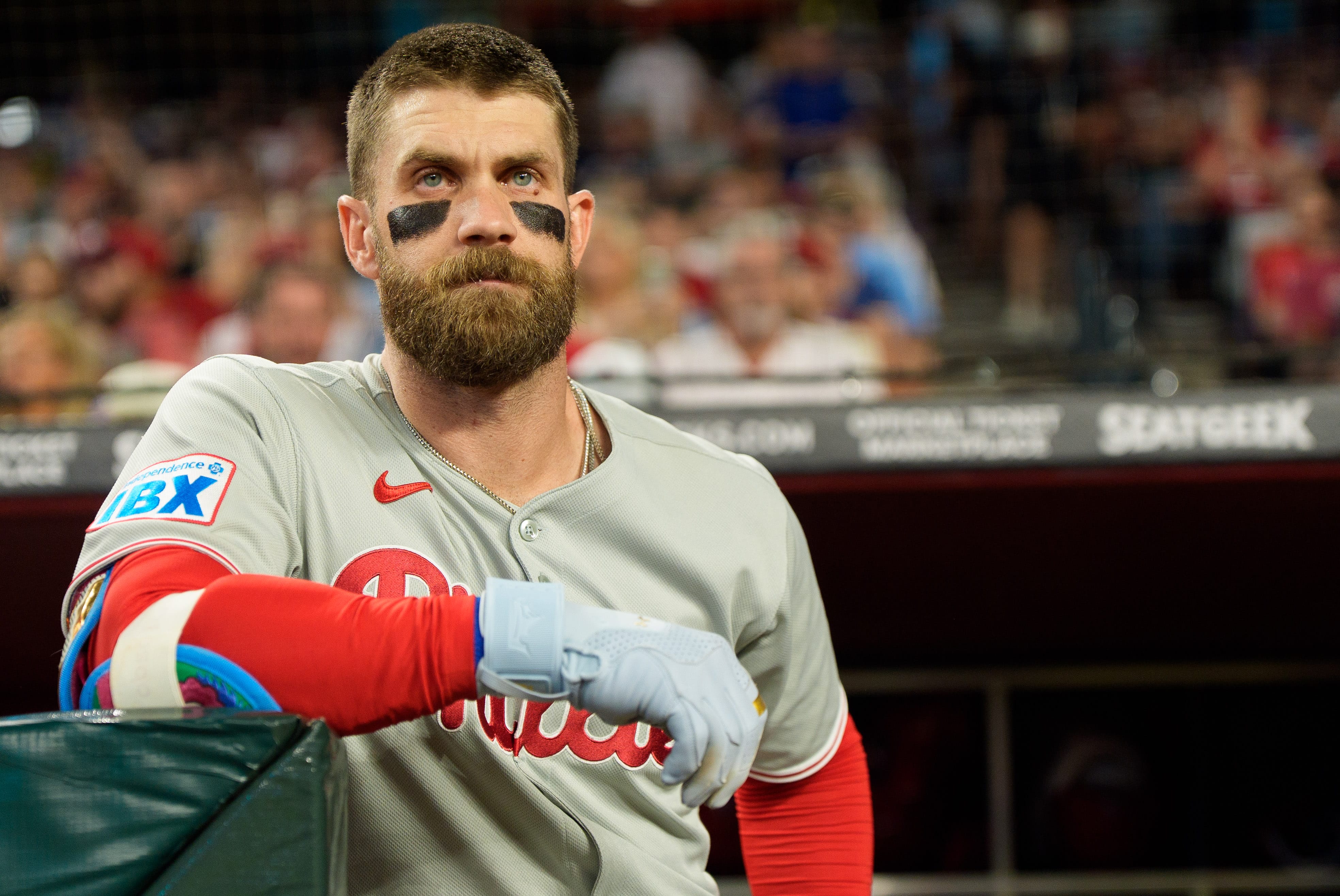
It was one of those moments in sports that arrives already carrying myth.
The eighth inning of the World Baseball Classic semifinal. United States and Venezuela, a country with baseball as its biggest export outside of crude oil, looking for its Miracle on Diamond moment. LoanDepot Park in Miami vibrating with that international kind of tension — louder, rawer, more desperate than a normal March night has any right to be. Team USA was losing, 2-0. The lineup had been searching for oxygen most of the evening. The game was slipping. The ballpark knew it. The dugout knew it. Every person watching knew it.
And then Bryce Harper walked to the plate.

One man on. Two outs. One swing from deliverance or despair.
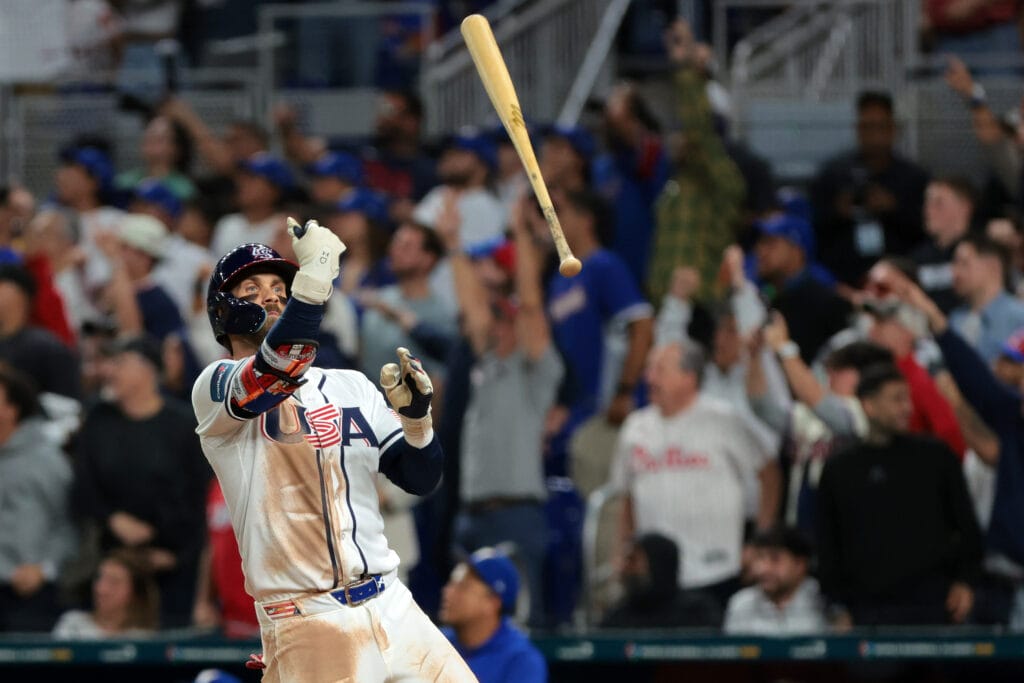
Silvino Bracho tried to get him to chase a pitch out over the plate, and Harper didn’t just swing. He attacked it. He turned on it with that violent elegance that only belongs to a handful of hitters in the history of the game, the kind of swing that begins in the ground and climbs through the body like conviction. The crack came first — that unmistakable Harper sound, different from everyone else’s — and then the ball took flight to right field, carrying with it all the panic of the inning and all the hope of the moment.
Two-run homer.
America tied.
Ballgame changed.
It was baseball at its most human: pressure, noise, risk, consequence, release. It was the kind of moment that reminds you why the sport matters in the first place, why people fall in love with it, why children imitate swings in the backyard and grown men still talk about home runs they saw 40 years ago.
“The sound is different when Bryce hits it like that,” Alex Rodriguez, who was there as an analyst for Fox, told me. “He’s wired for moments like that. He’s just different.”
That, really, is the whole argument.
Bryce Harper is different.
And in a baseball world increasingly obsessed with reducing everything to formulas, acronyms, probabilities and process, I think it’s worth saying plainly that some greatness still lives outside the spreadsheet. Some greatness still announces itself to your eyes, your gut, your pulse. Some greatness is not just what a player accumulates. It is what he summons.
And nobody in Philadelphia should ever apologize for loving that about Bryce Harper.
There are players who survive the big moment.
There are players who endure it.
And then there are the rare few who seem to be pulled toward it, who want the stage to get hotter, the lights brighter, the consequences steeper.
“You gonna be the man? You gonna be the man,” Charlie Manuel told me. “Nobody’s stopping you.”
Meaning all players want to be the man but few players have the courage.
“Harper ain’t afraid,” Manuel said.
Larry Bowa sees it clearly.
“He didn’t have a good World Baseball Classic up until the game was on the line,” Bowa told me. “Then he does Harp and comes up big. He’s unbelievable. He can be 0 for 20 and it doesn’t matter. He’ll win the game for you.”
That is not a normal compliment. That is not, “He has a good OPS,” or, “He controls the strike zone,” or, “He had a strong hard-hit rate.” That is a baseball man talking about something older and more elemental. Something that cannot be cleanly graphed.
Harper can fail for three at-bats, four at-bats, a week, even longer, and still make you believe that the next swing might be the one that changes the game. In fact, part of his greatness is that failure does not seem to frighten him away from the next opportunity. If anything, it appears to sharpen him.
Bowa made a comparison that tells you everything about the class of competitor Harper belongs in.
“He reminds me of Jeter,” he said. “Jeter rose to the occasion in the seventh, eighth, ninth inning. He wanted to be up with the game on the line. Didn’t matter if he was 0-for-3 with the three strikeouts, he wanted that at-bat to win the game. Like Harp.”
That’s it.
Not everybody wants that at-bat.
Everybody says they do. Not everybody truly does.
Baseball is too hard, too humbling, too exposing. The sport builds failure into its bones. Even the best hitters spend a lifetime making outs. Slumps are public. Doubt is public. And when the closer comes out of the bullpen and the whole building rises and the game hangs there waiting for somebody to claim it, a lot of hitters are not eager for all that weight.
Harper is.
“You tell him you’ve struck out three times and the closer with 30 saves is on the mound,” Bowa said, “he’d jump at the opportunity. He’s got that attitude, boy.”
A-Rod said something that should be framed and put in every batting cage in America.
“When you’re truly great,” he said, “there is something inside you that you must swing in certain moments. It’s wiring. It’s not ego.”
That is beautifully said. Because too many people mistake aggression for vanity. They think the superstar who wants the moment is trying to author a movie about himself.
No.
The great ones do not chase applause. Often they obey something deeper. A kind of internal law. A conviction that the moment belongs to them because they are willing to own its consequences.
That is Harper all over.
One of the hardest things in sports is not becoming a star.
It is being told you are going to be one before you are old enough to drive, and then somehow carrying that weight all the way into adulthood without collapsing under it.
Harper has been under the microscope since he was 14 years old. Before the Phillies. Before Washington. Before the MVPs. Before October at Citizens Bank Park became his own private theater. Before the beard and the headbands and the home run trots and the thunder.
He was the chosen one.
“He’s just rare, man,” Bowa said. “Think about it. He’s been under the microscope since he was 14 years old. Imagine how hard that is — year after year — to live up to those expectations. But he’s done it. Gotta wear on you after a while. Not him.”
We talk all the time about the physical demands of greatness, but the emotional demand may be even greater. Everybody had an opinion on Bryce Harper before Bryce Harper was Bryce Harper. Everybody had a projection, a demand, a suspicion, a headline ready to go. He was on the cover. He was traveling to tournaments as a baseball prodigy. He was already a symbol before he was a man.
And yet he didn’t just survive the prophecy. He fulfilled it.
Former big leaguer David Segui gave me one of the best Harper stories I’ve ever heard because it captures both the myth and the person.
Harper was 17, enrolled at the College of Southern Nevada in Henderson, outside Las Vegas. Segui’s son, Cory, was going to be Harper’s teammate, and the dads arranged a hitting session. Segui threw batting practice for three hours.
He went in skeptical.
“I heard all the hype,” Segui said. “Remember thinking, okay, the kid’s probably talented but nobody’s that good. They never live up to the hype. But he did. Every bit of it.”
That is a staggering thing to say about a teenager whose legend was already circulating through the game like folklore.
Segui described Harper as “a kid in a man’s body,” with insane power and, even more impressively, a rare ability to control the bat.
“Never saw anyone that young with ability to control the bat, especially his opposite-field power,” Segui told me. “He really impressed me.”
And then came the image that feels like it belongs in a movie: Segui and Harper’s father, Ron, collecting baseballs between rounds and finding another half-bucket of them beyond the center field fence, in a gated area used to park buses. Twenty-five or thirty balls, easy. Bombs. Maybe 450 feet from home plate.
That’s the prodigy part.
That’s the legend part.
But Segui’s favorite part wasn’t the power. It was the humility.
He noticed Harper had a hole in his swing. He was yanking pitches on the inner half. Segui had just met him and didn’t want to overstep. And then Harper stopped and asked him, “Mr. Segui, what do you see there?”
That is who he was. The chosen one asking to be taught.
Segui was blown away.
“The lack of ego in him wanting to learn,” he said. “That’s what stood out more than the bombs.”
Read that again. More than the bombs.
The greatest prospects are usually discussed like weather systems — too large, too loud, too forceful. But what allowed Harper to turn prophecy into a real career was not just his gifts. It was that, deep down, he remained coachable. Curious. Grounded. Segui said anybody who met Bryce’s father, the Vegas iron worker, would know “there’s no entitlement there,” just a blue-collar, hard-working iron worker who raised his kid right.
That matters.
The chosen one story usually breaks one of two ways. The player either never meets the expectations, or he meets them in numbers but loses himself in the process. Harper has somehow held on to both the force and the humanity. The swagger and the openness. The showmanship and the work.
That is rare too.
We live in a numbers-dominated world. Everything now has to be converted into a metric to be trusted. We don’t just want to watch. We want to quantify what we watched. We don’t just want to admire greatness. We want to run it through a machine and see if the machine agrees.
And I think something gets lost there.
Not because numbers are useless. They aren’t. Of course they have value. Of course information matters. Of course teams should study tendencies and matchups and angles and probabilities. That has always been part of the sport, even if in a rudimentary way compared to now.
But there is a point where analysis stops illuminating the game and starts draining the blood out of it.
There is a point where our reliance on acronyms becomes a form of mistrust — mistrust of our own eyes, of our own instincts, of the very human gift of feeling.
A-Rod cut right to it.
“Too much thinking going on in baseball,” he said. “You have to feel it. Believe it.”
Amen.
Segui, who came from a different baseball era but understands hitters as well as anybody, had a similar reaction.
“The numbers have their value,” he said. “I never walked up to the plate and worried about the number of revolutions on a guy’s slider. What we say … does it have bite? Is it sharp? Does it snap? Can you pick it up?”
Somewhere along the line, the tool became the tablet, and Numbers became a made-up religion.
“I’m all for nerds having paying jobs in the game,” Segui said. “That stuff is cute and entertaining over a bottle of wine.”
That is terrific.
Because that’s exactly how a lot of this stuff feels now. Cute. Entertaining. Interesting in the abstract. But not always useful in the part of baseball that matters most: when the pitcher is on the mound, the count is live and the hitter has to compete.
Segui laughed about hitters taking one swing in the cage, then walking around to inspect an iPad on a tripod. He thinks it can get in the way of rhythm. In the way of feel. In the way of being an athlete instead of an engineer.
“The ball don’t lie,” he said.
And there is real wisdom in that.
The danger is not that analytics exist. The danger is that analytics become the lens through which we define reality itself. That “elite” becomes an acronym instead of a sensation. That we are so eager to prove we are smart that we forget to acknowledge what is obvious.
Bryce Harper is the obvious.
Not in the shallow sense. In the deep sense.
He looks different in the box. He carries himself different. The moment treats him different because he treats the moment like a living thing. That cannot all be captured in formulas, especially when the formula tries to flatten context. A late-game at-bat in October is not the same thing as a second-inning at-bat in May. A man who wants that at-bat is not the same thing as a man who merely survives it.
That’s the point.
The game’s humanity lives in the flashbulb moments. The pressure. The risk. The choice to attack. The stadium holding its breath. The drama. That’s what we love. That’s what sports are built on. That’s what gives an athlete immortality.
Harper gives you that.
And I am not interested in apologizing for valuing it.
This is where the discussion around Harper gets interesting.
Because yes, there is a tension here. The same aggression that makes him so alive in the biggest moments can also drag him into expanding the zone. The same urge that makes him dangerous can, at times, make him vulnerable.
Segui understands that better than most.
“It’s a catch-22 on how much to expand the zone,” he said. “Sometimes you take a walk and pass the baton. Sometimes you want that guy to swing the bat. With a base open, most of the time it’s stupid to pitch to Bryce Harper. You expand the zone and hope he gets himself out.”
That’s real. That’s honest. It is not some cartoon anti-analytics rant. It is the reality of hitting. Sometimes the pitcher is telling you that you are not getting a pitch to drive and your job is to live for the next guy. Sometimes discipline is a weapon.
But Bowa, in classic Bowa fashion, also makes the equally compelling counterargument.
“I don’t want him to walk 140 times,” he said. “We got a runner on third and less than two outs and you got a pitcher who is 2-3 inches off the plate, I want him hacking. Get me a fly ball or a base hit.”
There it is. The tension between theory and consequence. Between the idealized plate appearance and the actual run-scoring moment.
Bowa’s line should be tattooed on every front office wall.
“The name of the game is to get more runs than the other team — not walks.”
Now, that doesn’t mean Bryce should be reckless. It doesn’t mean every expansion is noble. It doesn’t mean there is no wisdom in patience. But it does mean that baseball conversation has tilted so heavily toward process that sometimes we forget outcome is still the point. The game is not won by moral victories at the plate. It is won by crossing home plate.
Bryce addressed it. He said this spring he’d like to walk 130 times.
Bowa put it in the earthy terms only he can.
“How ’bout 130 ribbies? That’s what I want.”
And with Trea Turner, Kyle Schwarber and eventually a wave of traffic in front of Harper, that’s not an unreasonable desire.
The deeper point is this: Harper is not a spreadsheet challenge. He is an event creator. A run producer. A force. His job is not merely to be statistically proper. His job is to change games.
This is where I come back to the whole conversation about whether Harper is still “elite.”
We know how this stuff works now. Somebody says something in a nuanced way. It gets twisted. The internet grabs one piece of it and turns it into a proclamation. Everybody sprints to outrage. Context dies. The cycle spins.
Larry Bowa knows Dave Dombrowski, and he was careful here.
“I don’t think he meant that Harp is not elite,” Bowa said. “All he meant was Harp had a good year, not a great year. But it’s funny if you break down Harp’s numbers … he missed a lot of time and still put up numbers.”
That’s fair. That’s sane. And it’s probably closer to the truth.
But the reason the whole debate touched a nerve is because it exposed how much of our definition of elite has been outsourced to acronyms. Elite now gets treated like a certificate stamped by a formula. If a player doesn’t fit the favored language of the day, then somehow his greatness is up for debate.
I reject that.
Bryce Harper is elite because he alters games, because opposing teams organize entire nights around him, because pitchers still work around him, because the crowd still rises differently when he comes up, because he still produces moments that live, because he still carries danger, because he still bends atmosphere.
Segui put it cleanly: “He’s that dude.”
That’s baseball language. And sometimes baseball language says more than any model ever will.
Bowa also said something I loved: Harper doesn’t need some perceived slight to manufacture motivation.
“This guy gets motivated by putting on the uniform.”
That is a beautiful description of a star who has not lost the romance of the job.
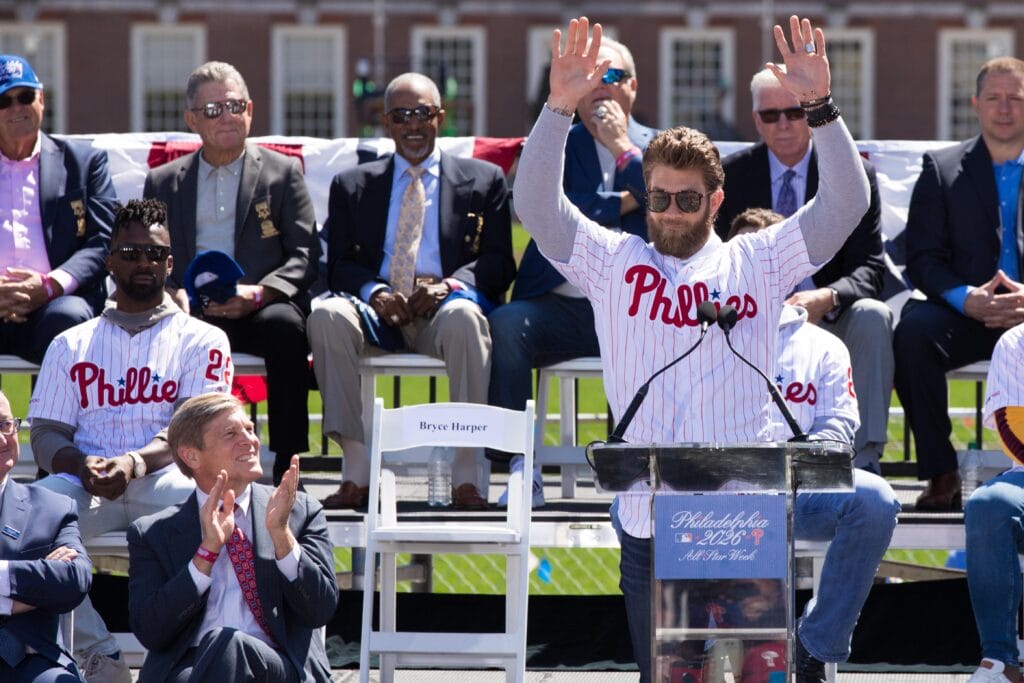
This city doesn’t ask for polish. It asks for commitment. It asks for edge. It asks for authenticity. It asks whether you are really in or just passing through.
Harper loves back. He made his answer years ago.
“He’s embraced it,” Bowa said. “He committed to being here. He didn’t want any opt outs.”
That matters in this era, maybe more than ever. When stars build escape hatches into everything, when contracts come with contingency plans, when loyalty is too often treated as something quaint, Harper said the opposite. I want to be here.
Not for the sunny part. The whole thing.
Bowa said he doesn’t even think Harper would ask out if things went sideways years down the road. He just doesn’t see Harper saying, “Get me outta here.”
I don’t either.
Because Harper’s Philadelphia life has not been an act. You see it in the obvious things — the Phanatic socks, the Phanatic cleats, the skyline bats, the way he leans into the civic theater of it all. But you also see it in the less theatrical thing: the permanence of his posture.
He belongs here because he has chosen to belong here.
And Philadelphia, for all its hard edges, loves nothing more than a star who makes that kind of pledge.
Of course there is one shadow hanging over all of it.
He hasn’t won it.
The Phillies haven’t finished the job.
And somehow, in the crude way sports discourse works, that absence becomes a stain on the player most associated with the dream.
That is unfair, but it is real.
Harper has already produced enough moments in Philadelphia to live forever here. The home run through the raindrops in Game 5 of the ‘22 NLCS that begets Bedlam at the Bank alone would have earned permanent residency in the city’s mythology. This piece was written that very moment, whilst standing next to my cousin, Joey, behind homeplate, soaking wet. Jumping and hugging like little kids when the ball left the bat. The sound A-Rod talked about echoed through the rain like a single boom of thunder.
It’s all there. The October theater. The noise. The bat spikes. The stare. The sense every fall that something impossible might happen if he is involved.
And yet because the parade has not come, some of the conversation tilts toward deficiency. What’s missing. What’s not yet sealed. What remains undone.
Bowa sees echoes of his own Phillies teams from the 1970s.
“You know they remind me of us back in the 70s,” he said. “We won three straight divisions and didn’t win it. Fans stop believing in us. We got tired of hearing it. I think these guys are tired of hearing it.”
That’s important.
This isn’t just a Bryce Burden. It belongs to the whole club. They all hear it. They all feel it. They know the narrative. They know what people say in October and November and all winter long. Great regular season. Good club. But can they finish?
Bowa senses they took inventory this spring. That the room understands what is at stake.
And Harper, as always, sits in the middle of that story.
Because he is the franchise’s emotional engine. The symbolic center. The player most likely to turn pressure into action.
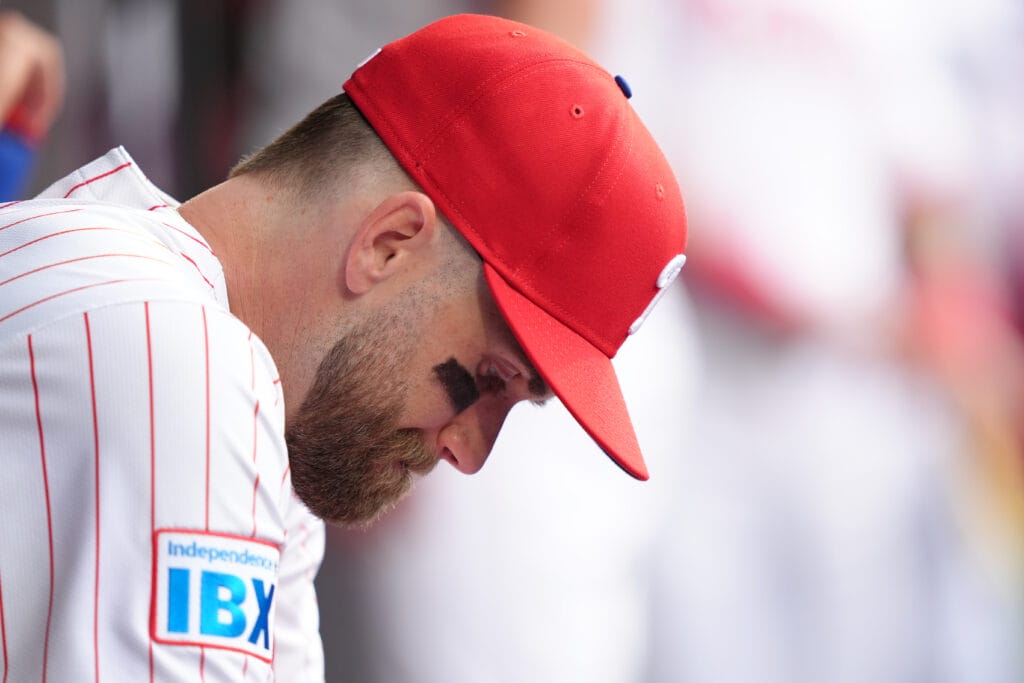
“There’s going to be a season when he breaks all the records,” Manuel said. “Stuff’s happened. He’s been hurt. You know, this might be the year he puts it all together. Then watch out, man.”
Maybe it is too dramatic to call it a revenge tour.
Then again, maybe not.
Maybe revenge is too clean a word. Maybe this is more like reaffirmation. Reassertion. A reminder.
A reminder that Bryce Harper still has a lot of baseball left. Segui thinks he has five to eight more really good years. Harper takes care of his body. He still plays hard. He still wants to play every day. He has already shifted positions more than once, from catcher long ago to the outfield to first base now, and Segui — a first baseman himself — admires the way Harper moves around the bag and what that willingness says about his ego, or lack thereof.
“I played with a lot of guys who would never have moved positions for the betterment of the team,” Segui said. “I’m proud of the guy.”
That line stuck with me.
Because the public version of Harper often gets reduced to heat and spectacle. But underneath it is a serious baseball player. A guy who cares. A guy who works. A guy who wants the team to function. A guy who still seems animated by the game itself, not just by what comes with it.
This season will ask a lot of the Phillies. It will ask a lot of Bohm in a contract year. It will ask whether the offense can sustain enough pressure. It will ask whether all that accumulated disappointment becomes fuel or weight.
And it will ask Harper, again, to be Harper.
To be the force.
To be the symbol.
To be the star who still attacks instead of waiting.
To be the player who trusts feeling in an increasingly artificial age.
That last part matters to me more than ever.
Because we are living in an AI world now, a world that loves calculation and prediction and model-building and certainty. And yet sports remain beautiful because they refuse to fully surrender to certainty. They are still governed by heartbeat. Still vulnerable to nerve. Still elevated by nerve. Still saved by audacity.
Bryce Harper represents that part of the game.
He is not anti-intelligence. He is anti-timidness.
He is a reminder that the human gift of feeling still matters. That a hitter is not just a processor. That greatness is not just a file. That some players have a sense of occasion you can see with your own eyes if you stop looking down at the screen long enough.
That is why I love him as a player.
Not because he is perfect. He can be as reckless as puppy zoomies, especially on the bases.
Not because he always makes the correct spreadsheet decision.
Not because every season closes with a trophy.
I love him because he plays like the game still has a soul.
Because he still runs toward the hardest moment.
Because in a world obsessed with measuring everything, Bryce Harper still gives you something you can only feel.
And maybe that’s the real definition of elite.
Not an acronym.
A heartbeat.